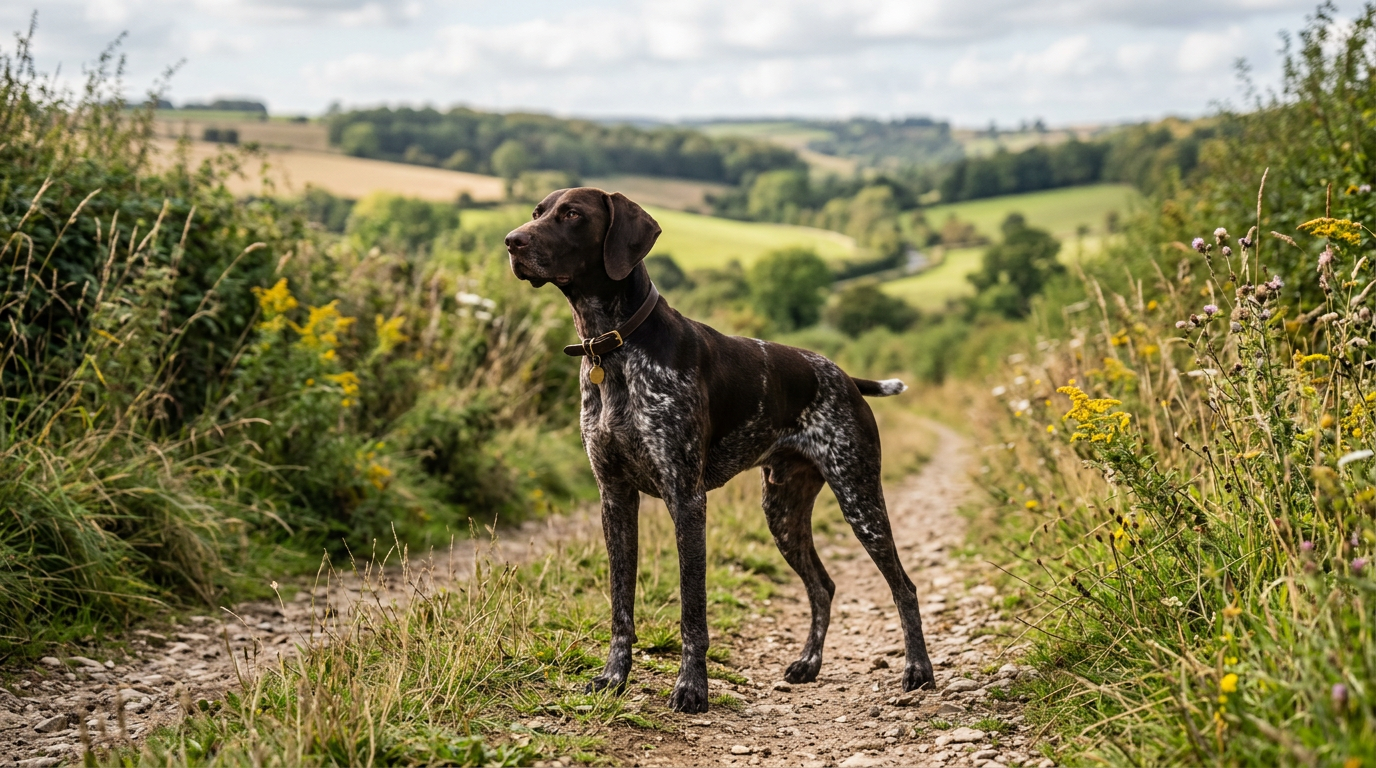
A German Shorthaired Pointer is built to search, run, point and retrieve across demanding terrain. This German Shorthaired Pointer breed guide explains what that working background means in a household: high daily activity, close human contact, serious recall training and careful management around wildlife. The breed is affectionate and highly trainable, but it is rarely a casual choice.
The key question is not whether you enjoy an occasional weekend hike. It is whether you can organise purposeful activity on wet weekdays, teach an athletic adolescent to settle, and keep it safe when a scent is more compelling than you are. A secure yard helps, but it cannot replace shared exercise and training.
German Shorthaired Pointer ratings
These are editorial suitability ratings, not scientific measurements or guarantees about an individual. Higher family and trainability scores indicate an easier fit. Higher exercise and grooming scores indicate more owner effort.
| Trait | Rating | Practical meaning |
|---|---|---|
| Family-friendly | 8/10 | Often affectionate and playful, but size, speed and intensity require supervision. |
| Exercise requirement | 10/10 | Needs substantial physical activity and mental work every day. |
| Grooming requirement | 4/10 | Short coat is straightforward, though shedding, ears, feet and nails still need attention. |
| Trainability | 9/10 | Learns quickly when rewards are meaningful and training accounts for prey drive. |
Breed overview
| Breed | German Shorthaired Pointer, often shortened to GSP |
|---|---|
| Origin and purpose | German versatile hunting dog developed to locate, point and retrieve game |
| Group | Sporting or gundog, depending on the registry |
| Male size reference | 23–25 inches (58–64 cm); 55–70 lb (25–32 kg) |
| Female size reference | 21–23 inches (53–58 cm); 45–60 lb (20–27 kg) |
| Lifespan reference | 10–12 years |
| Coat | Short, dense coat; commonly liver or black in solid, patched, ticked or roan patterns |
| Daily priorities | Exercise, scent work, recall, impulse control, secure management and rest |
| Best fit | Active owners with time for training and safe access to varied outdoor activity |
The size, weight and lifespan ranges above follow the American Kennel Club GSP profile. Breed references help with planning but do not determine the correct body weight or workload for an individual dog.
Size and weight
A GSP is a medium-to-large, lean, powerful athlete. Its long stride and quick acceleration require more usable space than the dog’s standing footprint suggests. A cluttered room, slippery floor or narrow gate can become a collision point when an adolescent becomes excited.
Measure chest girth and neck before choosing equipment. Check that a harness permits shoulder movement and cannot be reversed out of. Hardware should be strong enough for an adult’s power without being unnecessarily heavy. Recheck fit during puppy growth and after changes in weight or muscle.
Do not use the visible ribs of a very lean sporting dog—or the absence of visible ribs—as the only body-condition test. Ask your veterinary team to assess fat and muscle by touch. Maintain a record of weight, workload and diet because a working season, injury or change in routine can alter nutritional needs.
Lifespan and long-term commitment
A 10–12-year reference lifespan represents years of exercise planning, veterinary care and companionship. Think beyond the young dog’s speed. Can you adapt the routine after an injury, support an older dog’s mobility and still provide low-impact mental engagement?
Teach skills early that make future care easier: resting behind a gate, entering a vehicle calmly, accepting a harness and allowing body checks. Condition the dog to a stable ramp before it is medically necessary. A familiar piece of equipment is easier to use during recovery than one introduced alongside pain.
Watch for gradual change. Shorter strides, reluctance to jump into the car, repeated stiffness or reduced enthusiasm may be easy to dismiss in a dog that still wants to go. Document the pattern and arrange assessment rather than compensating with more encouragement.
Temperament and household life
Many GSPs are social, expressive and strongly attached to their people. They often want to participate in every activity, which can be delightful and exhausting. Independence in the field can coexist with difficulty being left alone. Practise calm separation before the household urgently needs it.
Young dogs can be physically exuberant. They may jump, mouth, steal objects or race through the house when overtired as well as when under-exercised. More running is not always the answer. A predictable rhythm of activity, food, calm training and sleep helps the dog learn to switch off.
Create a resting area away from the busiest doorway but close enough that the dog does not feel banished. Reward voluntary lying down while you cook or work. Build duration gradually. A mat settle should become a normal part of life, not a command used only when the dog is already overwhelmed.
Prey drive and scenting
Expect interest in birds, rabbits and fresh scent trails. Manage first: use a secure fence and a lead or long line where off-lead freedom would be unsafe. A garden fence should be assessed for height, gaps, climbable objects and gates that visitors might leave open.
Safe outlets can include structured scent searches, retrieving games, tracking-style exercises or appropriate gundog training. The AKC guidance on channelling prey drive explains why suitable outlets can support management. Do not let the dog harass wildlife in the name of enrichment.
Exercise requirements
German Shorthaired Pointers sit at the demanding end of companion-dog exercise. A healthy adult often needs well over a casual walk, but a fixed daily mileage is too blunt. Age, conditioning, surface, heat and health determine what is appropriate.
Build a plan from several components: aerobic movement, sniffing, skill work and recovery. One outing might combine brisk walking with recall repetitions on a long line. Another might involve swimming where safe, a scent trail or controlled retrieving. Include easier days rather than escalating intensity continuously.
Conditioning rather than exhausting
Increase distance or speed gradually. Weekend bursts do not replace weekday conditioning and can increase injury risk. Warm up with several minutes of controlled walking before faster movement, and cool down rather than stopping immediately after hard effort.
Observe movement during and after exercise. Repeated lagging, limping, shortened stride, reluctance to sit or stiffness the next morning means the plan needs reassessment. Stop for sudden pain, weakness, collapse or breathing difficulty and contact a veterinarian.
High arousal can look like endless energy. If a dog returns from an intense outing and cannot settle, try more predictable, lower-intensity work and teach an end-of-activity routine. Water, a quiet space and a calm food activity may support recovery. Do not use forced exercise to suppress distress or separation problems.
Puppies and adolescents
Puppies need frequent short exploration and play, not forced running beside a bicycle. Let the puppy move at its own pace on safe surfaces, provide ample sleep and avoid repetitive high-impact jumping. Ask the veterinarian how growth and vaccination status affect the plan.
Adolescence can produce an adult-sized athlete with unreliable judgement. Continue using long lines and barriers instead of assuming early puppy recall will survive every distraction. Channel enthusiasm into simple jobs and keep training criteria clear.
Heat, cold and water
Exercise early or late in hot weather, provide water and choose shaded routes. Stop if the dog struggles, becomes weak or cannot recover normally. A fit dog can still overheat, and enthusiasm is not proof of safety.
For swimming, check currents, water quality, entry and exit points. Use a well-fitted canine flotation aid where conditions warrant it. Rinse and dry the dog afterwards, especially ears and between toes, and prevent frantic repeated leaps from high banks or docks.
Building a sustainable activity routine
A useful German Shorthaired Pointer breed guide should distinguish exercise from constant excitement. The aim is a dog that can move powerfully, think around distractions and recover calmly. If every session ends with frantic behaviour, simply adding more speed may create a fitter dog with the same missing skills.
Example weekday structure
Begin with a morning outing that combines purposeful walking and sniffing. Add several short recall or lead exercises rather than demanding formal attention for the entire route. After breakfast, allow undisturbed rest. A midday toilet break can include a brief search or handling exercise without becoming another full workout.
Later, choose the day’s main activity: a longer walk, a controlled run for a conditioned adult, scent work, gundog training or a swimming session in safe conditions. Follow it with a cool-down and quiet period. In the evening, use low-key mat work, a suitable food activity or gentle grooming rather than another arousing chase game.
When weather cancels the usual plan
Prepare indoor options before a storm or heatwave. Hide portions of food around one room, lay a short scent trail, practise finding named toys or teach the dog to carry an object to a box. Keep floors non-slip and searches achievable. Mental work is useful, but it does not permanently replace outdoor movement.
A covered training space, trusted professional walker or secure hire field can be a backup. Check fencing and rules yourself. Do not assume a venue is escape-proof because it is advertised for dogs, and avoid crowded indoor spaces if they push your dog beyond its ability to focus.
Rest days and injury recovery
Planned easier days are part of conditioning. A dog can have a shorter sniff-focused walk and simple training without losing fitness. Watch sleep and mood after demanding activity. Repeated restlessness can reflect pain or overarousal as well as unmet exercise needs.
If a veterinarian prescribes restricted activity, follow the specific limits. Replace running with approved enrichment rather than inventing rehabilitation drills. Food searches, calm scent identification and stationary training may help, but even these need professional approval after surgery or significant injury.
Is your routine genuinely suitable?
List the times you can exercise the dog on five ordinary weekdays and identify who takes over during illness, overtime or travel. Price professional walking, secure-field hire, training and emergency care locally. A theoretical willingness to “be more active” is not the same as an established routine.
Consider location. Rural access may bring livestock, hunting activity and wildlife; urban access brings traffic, shared paths and limited off-lead space. Neither setting solves prey drive automatically. The right home provides controlled outlets and safe management.
Also assess household tolerance for a large adolescent that may be wet, muddy, vocal or unable to settle at first. If the family wants quiet companionship with occasional walks, a lower-demand adult dog or different breed is likely a kinder match.
Grooming
The short coat is relatively easy to maintain, but it does shed. Short, stiff hairs can work into upholstery and fabric, so regular brushing and realistic housekeeping expectations matter. Use grooming time to inspect a dog that frequently moves through grass, brush and water.
Weekly coat and skin check
Brush with a rubber curry or other short-coat tool recommended by a groomer. Work gently in the direction of hair growth. Check the chest, armpits, belly, feet and tail area for cuts, seeds, ticks, swelling or irritation after outdoor activity.
Do not pull an embedded grass awn or foreign body blindly. Sudden persistent licking, swelling, a draining tract, sneezing after field work or a painful eye needs veterinary attention. Coat gloss cannot tell you whether the dog’s nutrition or health is ideal.
Bathing and nails
Bathe when dirty with a dog-appropriate shampoo, rinse fully and dry the dog. Excessive bathing or harsh products can irritate skin. Persistent odour, dandruff, hair loss or itching is a reason for assessment rather than stronger fragrance.
Keep nails short enough for stable movement. Active dogs do not always wear every nail evenly, especially dewclaws. Introduce clippers or a grinder through short rewarded steps, and seek professional help if the dog struggles or nails have become overgrown.
Ear care for an active swimmer
Drop ears and water exposure make routine checks useful. Look for redness, discharge, odour, pain or repeated head shaking. The VCA swimmer’s-ear guidance recommends drying ears after swimming and using only veterinarian-approved cleaners.
Do not insert cotton buds into the canal or use a homemade mixture on inflamed skin. Recurrent infections need diagnosis because allergies, anatomy and other factors may contribute. Medication left from a previous episode may not treat the current cause.
Feeding
Choose a complete diet suitable for life stage and the dog’s actual workload. The WSAVA nutrition resources include questions for evaluating food manufacturers and tools for body and muscle condition. A sporting image on the bag does not prove the formula suits your dog.
Measure the daily allocation and include training rewards, chews and scraps. A highly active dog may need more energy during a working period and less during recovery or winter downtime. Adjust using weight, body condition, muscle and performance with veterinary guidance.
Puppies
Feed a complete growth diet appropriate for the expected adult size. Follow the veterinarian’s meal-frequency advice and monitor growth rather than trying to produce rapid weight gain. Do not add calcium, vitamins or performance supplements unless they are recommended for a defined reason.
Active adults
Record workload and feeding together. If a dog loses condition during sustained training, discuss timing, energy density and meal size with the vet rather than simply doubling portions. Appetite, stool quality and recovery are useful observations, but they do not replace nutritional assessment.
Carry water and appropriate food on long outings. Avoid abrupt diet changes during travel or competition. Store food securely: a driven, food-motivated dog may open bags or containers, and a large unplanned meal creates health risks.
Meal timing and bloat awareness
Gastric dilatation-volvulus, or GDV, is an acute condition in which the stomach dilates and twists. Deep-chested dogs are at increased risk. Discuss meal patterns, exercise around meals and preventive gastropexy with your veterinarian; online rules cannot calculate an individual dog’s risk.
Repeated unproductive retching, restlessness, heavy drooling, breathing difficulty, a swollen abdomen, weakness or collapse is an emergency. The Cornell GDV overview stresses the need for immediate medical and surgical intervention. Call the emergency clinic and leave promptly.
Common health considerations
This section supports informed questions, not self-diagnosis. The national breed club’s current CHIC list includes hip, elbow, cardiac and ophthalmologist evaluations plus a cone-degeneration DNA test. Screening reduces uncertainty for breeding decisions but cannot guarantee a puppy’s lifelong health.
Hip and elbow dysplasia
Hip and elbow dysplasia involve abnormal joint development and can contribute to pain and arthritis. Ask to see identifiable results for both parents and verify them in the relevant registry. A dog’s athletic appearance or lack of limping does not substitute for formal screening.
For a pet, watch for stiffness, reluctance to rise, lameness, reduced stride or a change in willingness to jump. Diagnosis and management may involve examination and imaging, weight control, modified activity, rehabilitation, medication or surgery. Never give human pain medication unless specifically directed by a veterinarian.
Cardiac screening
A cardiac exam is part of the recommended health-testing framework. Ask who performed the evaluation, when it occurred and what it covered. A routine puppy check and a breeding cardiac clearance are not necessarily the same.
Reduced exercise tolerance, collapse, unusual breathing or persistent coughing needs veterinary assessment. These signs have many causes and should not be assigned to poor fitness without investigation. Urgent breathing difficulty or collapse requires emergency advice.
Eye examinations and cone degeneration
Breeding dogs should have the recommended ophthalmologist examination, and the GSP-specific cone-degeneration DNA test should be documented. Cone degeneration affects daylight vision; the German Shorthaired Pointer Club of America CHIC page explains registration of the test.
Request the actual parent results rather than a statement that a general DNA panel was clear. In your dog, squinting, redness, a painful eye, cloudiness or sudden trouble navigating requires prompt veterinary attention. Do not use leftover eye drops.
Skin, ears and allergies
Active outdoor dogs encounter plants, insects and water, but repeated itching is not always an environmental nuisance. Note whether signs involve feet, ears, belly or a particular season. Veterinary assessment can distinguish infection, parasites, allergy and other causes.
Check parasite prevention with a professional familiar with your region and activities. Hunting and travel can alter exposure. Use products for the correct species and current weight, and never split a larger animal’s dose without explicit professional instructions.
Emergency and injury planning
Know the closest emergency clinic to your regular exercise areas, not only to home. Carry a basic canine first-aid kit, water, identification and a charged phone, but do not let supplies create false confidence. First aid stabilises while professional care is reached.
After strenuous activity, collapse, disorientation, severe weakness, uncontrolled bleeding, repeated vomiting, a suspected snake bite or breathing difficulty needs urgent help. Move an injured dog carefully and call ahead. Do not force an animal with possible spinal or limb injury to walk for a video.
Health testing and choosing a breeder
Use the GSPCA CHIC requirements as a checklist: hips, elbows, cardiac, eyes and cone degeneration. Confirm current rules when buying because requirements can change. Search the OFA database by registered name or number where applicable.
Ask about longevity, cancer, seizures, allergies, temperament and working soundness in close relatives. No single test covers all health. A thoughtful breeder explains what was tested, what was not, and how the pairing was selected.
Observe adult dogs if possible. Look for comfortable movement, stable social behaviour and an ability to settle after activity. Puppies should have veterinary records, clean living space, age-appropriate experiences and rest rather than constant stimulation.
Read the contract before paying. It should identify the parties and dog, state health information, describe support and explain what happens if you cannot keep the dog. Registry papers, colour and field titles are not substitutes for health documentation and a suitable temperament.
Training a German Shorthaired Pointer
Begin with reward-based training. The RSPCA training guidance recommends short sessions with limited distraction. GSPs learn rapidly, so make the rules consistent: behaviours that sometimes earn access to a door, bird scent or play become persistent.
Foundation skills
Prioritise name response, recall, loose-lead walking, a wait at doors, object exchange, mat settling and cooperative care. Practise each in easy settings before adding distance or excitement. Reward the behaviour promptly so the dog knows what worked.
Impulse control does not mean suppressing every natural interest. Teach a pattern: notice a distraction, return attention, earn an appropriate outlet. A sniff or retrieve can be the reward after the dog checks in.
Recall and long-line work
Start recall indoors and in a secure yard. Say the cue once, move away and reward the approach generously. Sometimes release the dog back to exploring so recall does not always predict the end of freedom.
Progress to a long line attached to suitable equipment in open, low-risk areas. Wear gloves if advised and learn to manage the line without wrapping it around hands or legs. Do not use a long line beside traffic, around dense obstacles or where it can endanger other people.
Watch for the earliest signs of scent fixation: head lift, sudden stillness, scanning or a rapid change of direction. Cue while the dog can still respond and reinforce heavily. If it repeatedly reaches the end of the line, add distance from the distraction and simplify the exercise.
Off-lead access is a risk decision, not a graduation every dog must reach. Wildlife, roads, livestock and local rules matter. A fenced field, long line or structured dog sport can provide meaningful freedom without gambling on an unfinished recall.
Loose-lead walking
Use separate equipment or a verbal cue if you want to distinguish relaxed walking from a pulling sport. For ordinary walks, reward slack near you, pause when the lead becomes tight and continue when the dog returns. Allow planned sniffing so the whole outing is not a precision exercise.
Begin away from wildlife hotspots. The dog cannot learn lead mechanics while fully absorbed in a scent trail. Build difficulty across weeks, and ensure every handler follows the same rule about whether pulling gains forward movement.
Retrieving without chaos
Use low, controlled throws on safe ground. Teach a start cue, a return and an exchange, then finish while the dog remains able to think. Do not throw sticks: splinters and impacts can cause serious injuries. Use a suitable dummy or toy that is large enough not to swallow.
Prevent repetitive twisting, high jumping and endless sprints. A retrieve session is training, not a machine for exhaustion. Mix in steadiness, searching and carrying so the dog’s brain works alongside its body.
Settling and time alone
Teach relaxation after needs have been met, not only after total exhaustion. Reward the dog for lying on its mat while you remain nearby. Gradually add household movement, then short periods behind a gate and brief absences.
Use a camera to check what actually happens when you leave. Persistent pacing, barking, drooling, destruction around exits or escape attempts can indicate distress. Arrange care and involve a veterinarian or qualified behaviour professional; a longer run does not treat panic.
Good with children?
Many GSPs are affectionate family dogs, but their speed, size and exuberance can knock over a small child without aggression. Adults must supervise and separate during high-energy play. A dog that has just returned from exercise may still need time to settle before joining children.
Teach children not to ride, hug, chase or disturb the dog while it eats or sleeps. Give the dog a child-free resting area and make it genuinely off limits. Children should call an adult if the dog takes an object rather than reaching into its mouth.
Family games should have rules. A child can scatter food for a supervised search, cue a simple hand target or help prepare a puzzle. Adults handle the lead, recall around distractions and any conflict. If mouthing, guarding or rough play emerges, get professional help early.
Good with cats and other pets?
A GSP’s hunting background makes cat suitability highly individual. A dog raised calmly with a confident resident cat may coexist well; another may fixate or chase. Ask about demonstrated behaviour, not a general claim that the breed is friendly.
Begin with separate zones and scent exchange. Use a secure barrier for visual introductions, keep the dog at a workable distance and reward looking away. The cat needs high resting places and routes to food, water and litter that never require passing the dog.
Do not force face-to-face contact or allow one chase to “see what happens”. Chasing is intrinsically rewarding and can become more persistent. Small mammals and birds require secure physical separation. A dog bred to locate game should never be assumed safe with them.
With other dogs, match play styles and interrupt before arousal becomes reckless. One-to-one relationships are more informative than crowded dog-park behaviour. Resource management, rest and gradual introductions remain important in a multi-dog home.
Apartment suitability
A German Shorthaired Pointer is a difficult apartment choice, though not an impossible one for a highly committed household. Square footage is less important than daily access to safe exercise, noise management, lift or stair logistics and the dog’s ability to settle.
Plan the worst-weather weekday, not the ideal weekend. Identify routes, secure training spaces and backup activities. A balcony is not exercise space, and repeated corridor retrieves are unsafe and disruptive.
Put the resting area away from the shared entrance, teach a door routine and use a gate during deliveries. If corridor noises trigger barking, reduce exposure and practise calm responses at low intensity. Speak to neighbours early rather than letting a pattern become a housing dispute.
Consider alone time and toileting. A young or newly adopted dog may need more frequent access than a long lift journey allows. Professional walking can help, but confirm the walker can safely manage prey drive, equipment and heat.
Similar breeds to compare
| Breed | Why compare? | Difference to investigate |
|---|---|---|
| Vizsla | Short-coated, athletic pointing breed with close family attachment. | Compare sensitivity, coat, size and the individual lines’ working drive. |
| Weimaraner | Larger smooth-coated German hunting breed with substantial exercise needs. | Assess size, guarding tendencies, independence and separation tolerance. |
| German Wirehaired Pointer | Versatile German gundog with related work but a protective wire coat. | Compare grooming, temperament and working style rather than choosing by coat. |
| English Pointer | Athletic specialist pointing breed. | Investigate household temperament, training priorities and access to running. |
| Labrador Retriever | Sporting retriever commonly chosen by active families. | Still energetic, but often a different balance of retrieving, sociability and prey drive. |
Meet adult dogs from the lines or rescues you are considering. Labels such as “working” and “show” are not complete temperament descriptions. Ask for a normal day’s exercise, behaviour after activity and response to wildlife.
Recommended German Shorthaired Pointer products
These ratings assess product categories for a typical active GSP household. They are editorial judgements, not laboratory scores, hands-on brand reviews or guarantees. No affiliate purchase links are included. Select each item for the individual dog’s fit and activity.
| Product | Best for | Rating | What to check |
|---|---|---|---|
| Complete performance-appropriate food | Measured nutrition matched to workload | 10/10 | Life stage, manufacturer expertise, body condition and veterinary guidance |
| Escape-resistant Y-front harness | Everyday controlled walks | 9/10 | Shoulder freedom, secure straps and strong hardware |
| Fixed-length lead | Roads, car parks and training | 9/10 | Comfortable handle, reliable clip and suitable strength |
| Long line | Supervised recall and scent work | 9/10 | Safe material and length for the environment; handler instruction |
| High-visibility vest or light | Low-light outdoor visibility | 8/10 | Secure fit, movement freedom and visibility from multiple directions |
| Durable retrieving dummy | Controlled retrieves and searches | 8/10 | Correct size, no loose pieces and supervised use |
| Canine flotation aid | Boats and suitable water activity | 8/10 | Buoyancy, lifting handle, secure fit and free limb movement |
| Washable supportive bed | Recovery and mat settling | 9/10 | Enough space to stretch, stable base and removable cover |
| Short-coat grooming mitt | Loose hair and skin checks | 7/10 | Gentle material and comfortable handling |
Buy the safety essentials before novelty gear. Identification, strong walking equipment, a bed and water supplies support everyday life. Add sport equipment only after learning the activity from a qualified instructor.
Inspect stitching, clips and toys before each demanding outing. Replace damaged items promptly. A product marketed as indestructible still requires supervision, and a tracking device does not make unsafe off-lead access acceptable.
Adopting an adult German Shorthaired Pointer
An adult rescue may offer clearer information about size, exercise capacity and household behaviour. Ask for specific examples of recall, prey response, dog interactions, handling, time alone and settling after exercise. Find out whether observations came from a foster home, kennel or previous owner, since behaviour can differ by setting.
Request veterinary records and details of past injuries, ears, skin, digestive issues and medication. Arrange introductions under the rescue’s guidance and ask what support is available after adoption. Missing history is manageable when expectations are honest and an initial veterinary plan is in place.
First-month plan
Before arrival, arrange a veterinary visit, identify an emergency clinic and secure fences and gates. Confirm the current food and daily routine. Prepare a quiet bed, fitted walking equipment and barriers that prevent door escapes.
During the first week, prioritise rest, regular meals, toilet routines and calm exploration. Limit visitors and avoid testing the dog in the busiest park. Begin name response, mat work and gentle handling in short sessions.
In weeks two and three, add controlled outings, long-line recall and easy scent games according to age and health. Practise brief separations and review footage for signs of distress. Keep exercise increases gradual.
By week four, assess the real workload. Is the dog physically comfortable, able to settle and responding around mild distractions? Adjust the plan and book professional support for recall, prey drive, separation or overarousal before the behaviour becomes well rehearsed.
Ongoing owner checklist
- Provide appropriate physical and mental activity every day.
- Use secure management wherever wildlife, roads or livestock make recall failure dangerous.
- Measure food and adjust it to body condition and workload.
- Check coat, feet and ears after outdoor activity.
- Practise recall, loose-lead walking and settling throughout adulthood.
- Know the warning signs of GDV and the route to emergency care.
- Monitor gait, recovery, appetite and behaviour for meaningful changes.
Conclusion: is a GSP right for you?
This German Shorthaired Pointer breed guide describes a dog for people who enjoy building daily life around shared activity and training. A GSP offers athleticism, affection and remarkable working ability, but secure management and an off-switch are as important as miles covered.
Choose the individual carefully, verify health screening and prepare for adolescence before bringing the dog home. With suitable outlets, consistent reward-based training and protected recovery time, a German Shorthaired Pointer can become an exceptional active companion.
Related breed guides
Compare the German Shorthaired Pointer with the English Springer Spaniel breed guide and Whippet breed guide when assessing exercise, prey drive and training. Our Vizsla breed guide provides another active sporting-dog comparison.
Does this breed fit your life?
Use the dog lifestyle quiz to compare this breed with your home and routine, browse the breed database, or compare breeds side by side before deciding.