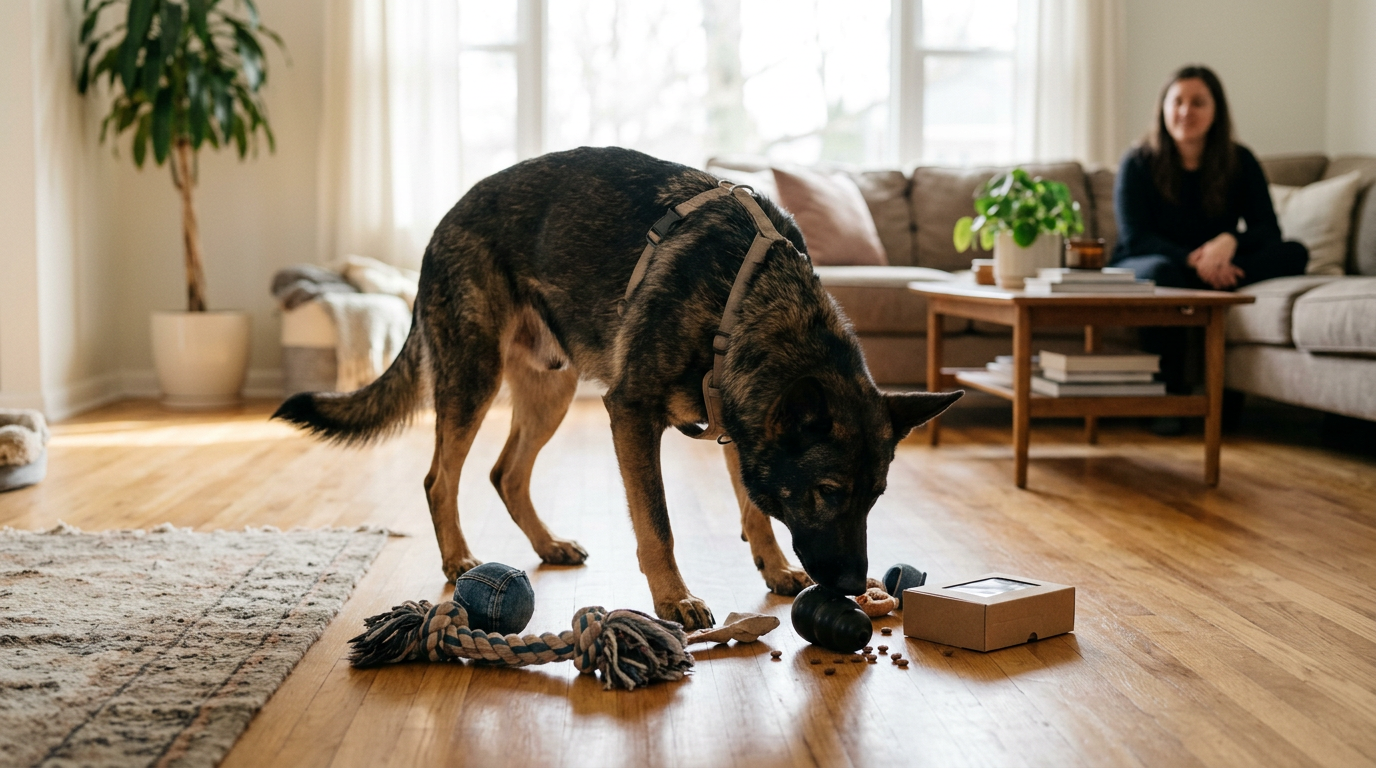
German Shepherd mental stimulation indoors works best when the activity is understandable, rewarding and easy to adjust. You do not need a room full of puzzle toys. A simple search or a short training task can give you a useful way to spend time together when outdoor plans change.
Indoor games supplement suitable exercise, rest and social contact; they do not replace those needs. Our German Shepherd breed guide covers the wider commitment. The examples below are optional starting ideas, not a fixed daily exercise prescription.
Set up for German Shepherd mental stimulation indoors
Choose a room with enough clear floor space to move comfortably. Put away breakables and items your dog could swallow. Use a non-slip surface and separate pets when food or toys might lead to competition. Supervise the activity rather than leaving a new homemade puzzle with the dog.
Take food rewards from an appropriate daily allowance where practical. Avoid setting a task so difficult that the dog resorts to destroying the container. If your dog guards food or objects, do not practise taking them away; ask a qualified professional for an individual plan.
1. Find a visible food reward
Place a small suitable reward where your dog can see it, then invite them to find it. Repeat in a few easy positions on the floor. The first goal is understanding the game, not searching the entire house.
Once the game is clear, make one location slightly less obvious while keeping it accessible. The AKC describes scent and problem-solving activities as ways to engage dogs. Avoid hiding food near cables, bins or furniture you do not want investigated later.
2. Touch a hand target
Present your open hand nearby and reward a voluntary nose touch. Start without moving around. When the dog understands the action, use a small change of position so they turn or take a comfortable step to reach it.
Keep your hand low enough for a natural movement. Do not turn the task into repeated jumping or spinning. This can also become a useful way to invite your dog to a position during ordinary training, but practise the skill in calm conditions before expecting it around distractions.
3. Investigate an easy food puzzle
The ASPCA’s enrichment guide includes food-based activities that turn part of a meal into an opportunity to explore. Use a sturdy, dog-appropriate puzzle and begin with the easiest arrangement. Let the dog see how food becomes available.
Watch the approach your dog chooses. Sniffing and gentle investigation are different from chewing off pieces. Stop if the materials are being swallowed, the dog becomes frustrated or the task is no longer safe. Difficulty is something you adjust, not something the dog has to endure.
4. Bring one familiar toy
Choose a toy your dog already enjoys carrying. Begin with it close to you and reward a voluntary return or delivery. If a reliable release is not established, work with a reward-based trainer on a comfortable exchange rather than pulling the toy out of the dog’s mouth.
Increase distance gradually on a clear, non-slip floor. Later, you can explore finding the same toy in a visible position. Do not assume your dog understands several toy names because they can retrieve one favourite object.
5. Practise settling on a mat
For the complete progression, use our guide to teaching a dog to settle on a mat, then place a mat in a quiet location and reward voluntary interest in it. Gradually reward comfortable pauses there. Keep your own movements calm and allow the dog to leave; this is not a test of how long they can be held in position.
Include quiet activities alongside more exciting games so every interaction does not become a request for faster movement. Rest is part of the day. You do not need to invent a new challenge whenever the dog lies down.
Example indoor enrichment rotation
- First opportunity: an easy search with part of a normal meal.
- Later: a few successful hand targets or a familiar toy game.
- Quiet period: a brief mat exercise followed by undisturbed rest.
This is an example of variety, not a minimum number of sessions. Shorten or skip an activity if the dog is tired, recovering from illness or no longer enjoying it. For restricted exercise after injury or surgery, ask the treating vet which activities are appropriate.
How to tell whether a game is helping
Look for willing participation and an ability to stop and settle afterwards. Frantic repetition, increasing frustration or refusal of a usually valued reward suggests the activity needs adjustment. Make the task easier, reduce distractions or finish.
Keep training reward-based. The AVSAB explanation of reward-based methods provides useful background. Persistent pacing, destruction or distress deserves assessment rather than an assumption that the dog simply needs harder puzzles.
Considering whether this breed suits your routine? Compare our Golden Retriever guide and review the housing questions in our guide to apartment-friendly dog breeds. Indoor floor space alone does not determine whether a dog’s needs can be met.
Still choosing the right dog?
Put this advice in context with the dog lifestyle quiz, browse practical profiles in the breed database, or compare breeds side by side.