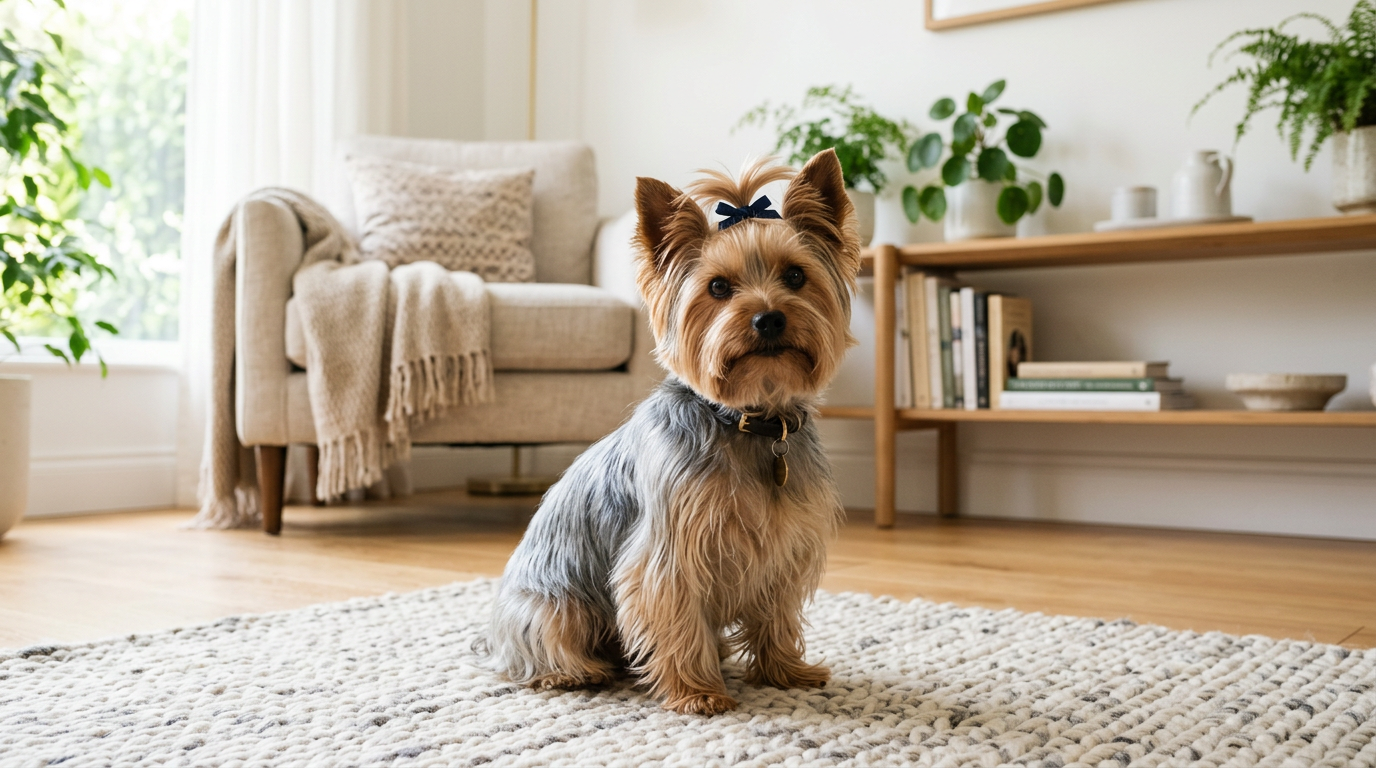
A Yorkshire Terrier can fit comfortably on your lap and still expect an interesting life beyond it. This Yorkshire Terrier breed guide explains the daily work behind that compact size: coat maintenance, careful handling, patient toilet training and enough activity to satisfy an alert little terrier. The breed suits owners who enjoy close companionship and can protect a small dog without preventing it from learning.
The main trade-off is straightforward. Yorkies need little physical space, but their grooming, dental care and training are not small commitments. A quiet adult may fit an apartment beautifully; a puppy left beside a busy window can spend the day practising its alarm bark. Choose for the routine you can provide, not the hairstyle you like in photographs.
Yorkshire Terrier ratings
These are editorial suitability ratings, not scientific measurements or guarantees about an individual dog. Higher family and trainability scores indicate an easier fit; higher exercise and grooming scores indicate more owner effort. Grooming assumes a long coat, with a practical short clip reducing the workload.
| Trait | Rating | What it means at home |
|---|---|---|
| Family-friendly | 7/10 | Can be affectionate and playful, but needs gentle handling and protection from rough play. |
| Exercise requirement | 5/10 | Daily walks, sniffing and short games; not a dog to keep permanently in a carrier. |
| Grooming requirement | 9/10 | Long hair needs daily attention; clipped pets still need combing and scheduled trims. |
| Trainability | 7/10 | Capable of useful everyday skills when rewards, timing and household rules are consistent. |
Breed overview
| Breed | Yorkshire Terrier, commonly called the Yorkie |
|---|---|
| Origin and background | British terrier with a ratting background; now widely kept as a companion |
| Size category | Toy-sized dog |
| Reference adult size | About 8 inches (20 cm) tall and around 7 lb (3.2 kg); individuals vary |
| Typical lifespan reference | 11–15 years, not a prediction for an individual |
| Coat | Long, fine hair; commonly maintained in a shorter pet trim |
| Daily priorities | Toilet opportunities, exploration, coat checks, dental care and undisturbed rest |
| Best household fit | Adults or considerate families with time for hands-on care and small-dog safety |
| Main challenges | Barking, grooming tolerance, toilet-training consistency and vulnerability during rough handling |
The American Kennel Club breed profile describes the Yorkie’s working-terrier background. That history is useful context, not an excuse to label every behaviour inevitable. A dog that investigates rustling leaves or follows a moving toy needs safe opportunities to explore; it also needs practice disengaging when the activity ends.
Ask to see ordinary behaviour before choosing a dog. Can it relax after visitors arrive? What happens when someone touches its feet? How does it respond to a dog passing at a distance? Those observations tell you more about the support it needs than a claim that all Yorkies are either fearless or nervous.
Size and weight: plan for the actual dog
The AKC’s Yorkshire Terrier ownership overview gives an approximate adult reference of 8 inches and 7 pounds. Pet Yorkies can be larger or smaller. A number on a breed chart is not a target to achieve by restricting food: your veterinarian should assess your dog’s frame, body fat and muscle.
Measure chest girth before ordering a harness. Check the manufacturer’s size chart rather than assuming “extra small” means the same thing across brands. On a tiny dog, a heavy clip, stiff strap or bulky buckle can interfere with comfortable movement. Recheck fit after grooming and during puppy growth, and test whether the dog can reverse out before using it outdoors.
Small size also changes your home layout. Inspect gaps under gates, balcony railings and spaces behind furniture from floor level. Put a stable bed where nobody is likely to step backwards onto it. Reclining chairs need particular care: locate the dog before moving the mechanism, and prevent access underneath.
Do not choose a puppy on a promise that it will stay exceptionally tiny. Ask for age, weight records, veterinary findings and information about the parents. If a seller prioritises miniature size over health documentation or dismisses poor appetite as normal, pause the purchase and seek independent veterinary advice.
“Teacup” is not a useful health credential. The Yorkshire Terrier Club of America’s member advertising rules prohibit terms including “teacup” and “tiny specialists”. Evaluate the dog and its records rather than treating a marketing label as proof of a desirable variety. Extreme smallness can make everyday feeding, handling and equipment choices more difficult; ask your veterinarian what that would mean for the puppy you are considering.
Lifespan and long-term commitment
An 11–15-year lifespan is a useful planning range, not a deadline or a guarantee. Think beyond the puppy year: grooming appointments, dental procedures, holiday care and changes in mobility may remain part of your budget for well over a decade. Check whether your likely housing and work arrangements can accommodate that commitment.
Keep a simple health record with weight, appetite changes, medicines and veterinary recommendations. Use the same weighing method each time where possible. A long coat can hide gradual changes, so do not rely only on photographs to judge condition.
For older Yorkies, make everyday routes easier before a fall or painful scramble occurs. Place non-slip runners between the bed, water and toilet exit. Choose a low-entry bed and help the dog avoid jumping from furniture. New night waking, house-soiling or reluctance to be touched deserves a veterinary assessment rather than being written off as ageing.
Temperament: affectionate, observant and worth listening to
Some Yorkies want to investigate every visitor; others prefer to watch from a safe distance. Give either dog an exit. Ask guests to sit down, avoid leaning over the dog and let it approach without being scooped up. A dog that chooses contact is easier to handle than one that learns human hands predict restraint.
Notice what happens before a bark or snap. A Yorkie may have already turned away, stiffened or tried to leave. Stop the interaction and make it easier next time. Growling is information about discomfort, not a challenge to win. Sudden handling sensitivity also warrants a health check, especially when grooming or chewing has changed.
Separate confidence from overexcitement. Racing between the window and door does not necessarily mean the dog needs a longer walk. It may need less visual stimulation and more help settling. Move the bed away from the busiest window, use a barrier during deliveries and reward quiet observation before barking starts.
A useful household rule is to offer invitations, not constant access. Invite the dog onto a safe lap when you can supervise; teach a comfortable floor bed for cooking, visitors and children’s play. This gives companionship a predictable place without requiring someone to carry the dog through every activity.
Exercise requirements
Plan daily outdoor movement and opportunities to sniff. As an illustrative starting routine for a healthy adult, try two comfortable 15–20-minute outings, with brief play or searching at home. This is not a minimum every Yorkie must complete. Fitness, weather, age and medical advice should determine the pace and duration.
Watch the dog rather than the clock. Repeatedly lagging, sitting down, limping or coughing is a reason to stop and investigate, not pull harder. Choose level routes with opportunities to turn back. Let a new dog build familiarity with a quiet stretch before asking it to manage traffic, crowds and unfamiliar dogs together.
Make indoor activity useful
Scatter part of a meal over a clean, non-slip area and let the dog search while you supervise. Start with food in plain sight, then make the search slightly harder. Alternatively, roll a suitable soft toy a short distance and reward bringing it back. Avoid high throws that encourage twisting or launching off furniture.
A short training session can supply another kind of effort. Practise walking to a mat, following a hand target or returning when called between two adults. End while the dog remains interested. Constantly escalating excitement is not the goal; being able to finish a game and rest is a useful skill too.
Outdoor equipment and weather
Use a well-fitted harness and lightweight fixed-length lead for routine walks. Keep enough slack for sniffing without allowing access to the road. In an enclosed, suitable space, a lightweight long line can support recall practice; supervise it to prevent tangling. A retractable lead is not the default choice near traffic or shared doorways.
Choose cooler walking times in hot weather and avoid surfaces that could burn paws. In wet or cold conditions, keep outings comfortable and dry the dog afterwards. A coat should allow free movement and toileting without rubbing. Never use clothing to justify remaining outdoors when the dog is shivering or distressed.
Grooming: choose a coat you can maintain
A long Yorkie coat is an ongoing project. If daily combing is unrealistic, arrange a shorter pet trim from the start. Short hair is a legitimate care choice, not an inferior version of the breed. The right length is one you can keep comfortable between appointments.
A practical combing session
Work on a stable, non-slip surface at a height that is safe for the dog. Keep sessions within its tolerance. Part a small section of hair, gently work through the ends, then check closer to the skin without scraping it. Follow brushing with a comb: a tidy surface can conceal tangles underneath.
Pay particular attention behind the ears, under the harness, around the armpits and along the legs. Support the hair near the skin so a tangle does not pull. Stop if the dog flinches or the coat is tightly matted. A groomer can advise whether clipping is safer than further detangling.
Do not cut tight mats with household scissors. Skin can be drawn into a mat, and a sudden movement can cause injury. Similarly, let a professional trim awkward areas around eyes, feet and the sanitary region if you cannot do so safely.
Baths, nails, ears and appointments
Agree a bathing and trimming schedule with the groomer based on coat length, skin condition and lifestyle. Use dog-appropriate products as directed, rinse thoroughly and dry gently. Keep water and shampoo out of the eyes and ears. A medicated shampoo should be used for a diagnosed need, not selected because the coat smells different.
Check nails and paw hair regularly; a slippery floor can become harder to manage when feet lack traction. Look for redness, discharge or a new smell when checking ears, but do not push cotton buds into the ear canal. Persistent scratching, sore skin or ear pain belongs with the vet.
Ask the groomer to record what the dog tolerated and which areas needed a shorter session. Practise those handling steps at home with rewards. Booking the next appointment before leaving helps prevent a manageable coat from becoming a difficult rescue groom.
Feeding a Yorkshire Terrier
Choose a complete diet suitable for the dog’s life stage and any diagnosed medical needs. A small mouth may find smaller pieces or an appropriate wet texture easier to manage, but a “Yorkie” label alone does not establish nutritional suitability. The WSAVA nutrition resources offer questions about food formulation, manufacturer expertise and individual nutritional assessment.
Use the feeding guide as a starting point and ask your veterinary team to adjust it to the actual dog. Weigh portions on a kitchen scale when practical. A casual handful is difficult to repeat, and a tiny dog’s training treats can become a substantial part of its intake. Set aside some normal food for rewards before serving meals.
A simple feeding record should identify the food, the daily quantity and who has served it. That prevents two people feeding breakfast or repeatedly topping up a bowl because the dog looks hopeful. Keep fresh water accessible, including when an indoor pen or gate limits the dog’s movements.
Puppies and missed meals
Ask for the puppy’s existing feeding schedule before collection and arrange veterinary advice on meal frequency. Very small puppies need particular attention to reliable intake. Do not deliberately fast a young toy-breed puppy to make it less fussy.
Weakness, tremors, disorientation, collapse or seizures require urgent veterinary advice. Low blood sugar is one possible cause, including in inadequately nourished toy-breed puppies, but symptoms cannot establish the diagnosis. See VCA’s explanation of hypoglycaemia. Do not force food or liquid into an animal that cannot swallow normally.
When a Yorkie seems fussy
First establish whether appetite has actually changed. Check food freshness, portion sizes and how many extras the dog receives. If refusal is new, persistent or accompanied by discomfort, vomiting, weight loss or unusual tiredness, contact the vet. Dental pain and illness should not be managed by endlessly rotating flavours.
For a healthy dog whose diet needs changing, follow a gradual transition agreed with your veterinary team. Keep the rest of the routine stable so you can identify what changed. Avoid adding several supplements at once, and do not restrict protein or start a therapeutic diet because a breed article mentions liver problems.
Common health considerations
These conditions are reasons for informed screening and observation, not a prediction that your Yorkie will develop them. This Yorkshire Terrier breed guide cannot diagnose symptoms or replace an examination. Discuss the dog’s own history, age and family background with a veterinarian.
Dental disease and retained puppy teeth
Make mouth checks part of puppy care. If a permanent tooth appears while the baby tooth remains beside it, arrange a veterinary appointment. Crowding can trap debris and affect alignment; do not wait for a chew toy to fix it. VCA’s retained-tooth guidance explains why prompt assessment matters.
Introduce toothbrushing gradually with dog toothpaste and a brush sized for the mouth. Begin with a brief lip lift and reward, then build towards comfortable brushing rather than forcing a full session immediately. Ask the veterinary team to demonstrate. Bad breath, bleeding gums, dropping food or reluctance to chew should prompt a dental check; home brushing does not remove established disease.
Dental products are additions to a care plan, not substitutes for examination and treatment. The Veterinary Oral Health Council accepted-products list identifies products assessed against plaque or tartar-control criteria. Check the exact product, age and weight guidance: an item sold for small dogs may still be unsuitable for a particularly small Yorkie.
Luxating patellas and changes in movement
A slipping kneecap, known as patellar luxation, is a recognised breed concern. The PDSA Yorkshire Terrier profile includes it among conditions prospective owners should discuss. Skipping a step, holding a hind leg up or repeatedly avoiding stairs warrants assessment rather than an assumption that the dog is being playful.
Take a short video of an intermittent gait change if you can do so without delaying care. Tell the vet when it occurs and whether it follows exercise or rest. Treatment depends on the findings. Do not manipulate the kneecap yourself or choose exercises from another dog’s recovery plan.
Tracheal collapse and coughing
Yorkies are among the small breeds associated with tracheal collapse. A persistent honking cough is a reason to consult the vet, but coughing has other causes, including heart disease. Diagnosis may require more than listening to the sound. Severe breathing difficulty or collapse is an emergency.
For affected dogs, veterinary management may include weight control, reducing airway irritants and using a harness instead of pressure on the neck. A harness is not a cure or a guarantee of prevention. VCA’s tracheal-collapse overview describes why individual diagnosis and treatment matter.
Liver shunts
Congenital portosystemic shunts allow some blood to bypass the liver, and Yorkshire Terriers are a predisposed breed. Poor growth, unusual behaviour, disorientation or seizures can be warning signs, although other illnesses can cause them too. Veterinary investigation may include blood and urine tests and imaging.
Ask what liver-related concerns occur in the family and what testing the breeder’s veterinarian has advised. A normal-looking puppy and a generic health guarantee do not answer those questions. See VCA’s liver-shunt explanation for background; suspected disease needs a personalised plan rather than home dietary experiments.
Eyes, skin and urinary changes
The breed’s health considerations also include eye disorders, skin allergies and bladder stones, as outlined by PDSA. Seek prompt advice for squinting, cloudiness or a painful eye. Repeated straining to urinate, particularly with little or no urine produced, needs urgent assessment. Persistent itching should not be dismissed as hair getting in the way.
Keep medicine and parasite-product dosing tied to a current weight and professional advice. Do not estimate a tiny dog’s dose by splitting a larger dog’s product unless the prescribing professional specifically directs it. Record reactions and treatments so a new clinic or holiday carer has accurate information.
Health screening before choosing a puppy
Use the Yorkshire Terrier Club of America’s health resources to prepare questions. Request the parents’ identifiable test reports, particularly patella and eye assessments, and ask your own vet whether the documentation meets current recommendations where you live. A statement that the parents are “vet checked” is not the same as named screening results.
Read dates, dog identifiers and results rather than accepting a screenshot heading alone. Ask which conditions cannot be excluded by those tests. For a rescue dog, request available clinical records, dental history, medicines and details of any coughing or lameness. Missing records do not make adoption impossible; they mean you need a plan to establish a baseline.
Training: teach the skills a small dog actually needs
Start with reward-based methods and small, achievable steps. The RSPCA training guidance recommends rewarding desired behaviour. With a Yorkie, equipment and handling should be especially considerate: pulling on the neck, cornering the dog or forcing physical positions is not necessary to teach useful household skills.
Toilet training without guesswork
Choose the toilet location and make access predictable. Take a puppy out after waking, meals and play, as well as often enough for its current needs. Stay nearby, keep the trip calm and reward promptly after toileting in the right place. Waiting until you return indoors can reward coming through the door instead.
Limit unsupervised access to spare rooms where accidents can go unnoticed. Use a safe pen or gated room when you cannot watch, with sleeping, water and any designated toilet area arranged separately. Confinement must suit the dog’s age and comfort; it is not a way to avoid providing breaks.
If indoor toileting is necessary, use one clearly defined surface and position. Decide whether it is a permanent solution or a temporary stage, then make any transition gradual. Scattered pads in every room can make the rule unclear. Clean accidents thoroughly with an appropriate pet cleaner and never punish a discovery made after the event.
Log accident times for several days. A pattern after evening play suggests a missed opportunity; accidents clustered around departures may need a different assessment. New house-soiling in a previously reliable adult, increased thirst or straining calls for a veterinary check rather than stricter rules.
Barking at doors and noises
Identify the trigger before choosing the exercise. A dog alarmed by corridor footsteps needs distance from the door and practice with manageable sounds. A dog barking for a toy may need a clearer start-and-finish routine. Shouting at both dogs treats different problems as though they were the same.
Practise a door routine when nobody is actually visiting. Send the dog to a mat behind a gate, reward, touch the handle and reward again if it remains comfortable. Add opening the door only when the earlier step is easy. For real deliveries, use management rather than turning every interruption into a difficult training test.
Reward checking in with you after a mild sound. If the dog cannot disengage, reduce the sound or increase distance. For related small-dog examples, see our guide to barking at household noises; adjust the exercises to your Yorkie’s response.
Recall, handling and settling
Practise recall indoors first: say the cue once, reward the approach and sometimes release the dog back to exploring. Outdoors, use a secure area or suitable line while the skill develops. Do not test an unproven recall near traffic, wildlife or unfamiliar dogs.
Teach a warning cue before lifting, then support both chest and hindquarters. Practise with brief, comfortable repetitions close to the floor. Being small does not make unexpected handling pleasant. For grooming, reward a moment of cooperation and pause when the dog needs a break.
A mat settle begins by rewarding voluntary steps onto the mat. Gradually reward remaining there while you sit nearby, then introduce mild household movement. Build duration separately from distractions. A dog that can rest while dinner is prepared has learned something more useful than performing a long list of tricks on demand.
Good with children?
A Yorkshire Terrier may be a good companion for children who can respect its size and boundaries. Suitability depends on the actual child, dog and adult supervision, not an age label alone. A calm older child who enjoys teaching a hand target is a different match from a toddler who grabs hair when excited.
Adults should manage lifting. Let children interact while seated on the floor, invite the dog over and stop if it moves away. Keep chasing games, wrestling and busy play with wheeled toys separate from the dog’s space. A Yorkie needs a child-free resting area that everyone treats as off limits.
Teach children to call an adult if the dog takes a toy or food item. Reaching into its mouth or dragging it from under furniture increases the chance of conflict. An adult can manage a safe exchange and prevent access next time. Supervision means actively watching and intervening, not merely being somewhere in the house.
Good with cats and other pets?
Some Yorkies live comfortably with cats, but terrier ancestry and individual chasing behaviour make introductions important. Ask about actual experience with cats; “friendly with dogs” is not evidence of cat compatibility. A cat also needs to feel safe, even if the Yorkie is smaller.
Begin with separate spaces and scent exchange, then brief visual contact through a secure barrier. Keep the dog at a distance where it can look away and respond to you. Reward disengagement. Give the cat high resting places and routes that do not require passing the dog to reach food, water or litter.
End a session if either animal remains tense, the dog fixates or chasing begins. Increase separation and seek professional help if progress stalls. Do not release them together to “sort it out”. Rabbits, rodents and other small pets need secure separation rather than an assumption that the Yorkie’s own size makes contact safe.
With other dogs, choose partners by play style as well as temperament. A friendly large dog can still knock a Yorkie over. Meet in a controlled space, allow breaks and stop repeated body slamming or pursuit. Crowded off-lead areas are not a requirement for a well-socialised dog.
Apartment suitability
Yorkies can suit apartments when toilet access, noise and safe movement are planned. Measure the journey from bed to toilet area, including lifts and locked doors. For a puppy, that journey may take longer than its warning signal allows. Keep the lead, keys and suitable footwear together so a toilet trip is not delayed by searching.
Place the main resting spot away from the front door and, if possible, away from the busiest shared wall. Use a gate to prevent rushing into the corridor when visitors arrive. Check balcony gaps carefully and never treat an unsupervised balcony as a safe exercise area.
Before choosing a dog, consider what happens during your longest regular absence. Arrange a trusted visitor or suitable care rather than assuming a small dog can wait indefinitely. If neighbours report barking, use observations or a camera to establish whether the trigger is corridor noise, isolation or something else. The solution depends on the cause.
Time alone and travel
Teach comfortable separation in small steps while you are still at home. Let the dog rest behind a gate with an appropriate activity while you remain nearby, then briefly move out of sight. Return before the situation becomes overwhelming and build according to the dog’s response, not a fixed timetable.
Repeated pacing, prolonged vocalising or frantic escape attempts deserve support from a vet or qualified behaviour professional. Another dog, a puzzle feeder or a longer walk may not resolve separation distress. Use temporary care arrangements while you work on the problem so daily life does not repeatedly exceed the dog’s coping ability.
For car journeys, choose a restraint or secured carrier appropriate to the dog’s size and the manufacturer’s directions. Practise entering it at home before travel. A lap is not a safe travel restraint. Keep identification current and pack the familiar food, prescribed medicines and veterinary contact information for overnight trips.
Similar breeds to compare
| Breed | Why compare it with a Yorkie? | Decision to investigate |
|---|---|---|
| Silky Terrier | A related-looking, silky-coated terrier that is generally larger. | Do you want more terrier activity and have room in your routine for it? |
| Maltese | A small companion with a long coat and substantial grooming needs. | Would this individual’s temperament and handling needs suit the household better? |
| Toy Poodle | A small, intelligent companion for owners who enjoy training. | Can you maintain its different coat and provide regular learning opportunities? |
The AKC profiles for the Silky Terrier and Maltese, plus its Poodle ownership overview, provide starting points for comparison. None is automatically quieter, healthier or easier to leave alone. Meet adult dogs, ask about coat upkeep and compare the daily routine rather than choosing from a photograph.
Would an adult Yorkie be a better fit?
An adult dog may make size, coat texture and established habits easier to assess. Ask a rescue or previous carer about a normal day, including time alone, toilet reliability and grooming tolerance. Request examples: “What happens when the brush comes out?” is more informative than “Is the dog good?”
Arrange introductions with household members and resident pets under the organisation’s guidance. Behaviour can change after a move, so even a settled adult needs a gradual transition. Ask what support is available if difficulties emerge and whether known health needs have been investigated. Choose with enough time to review the information, not under pressure to decide during a single meeting.
Recommended Yorkshire Terrier products
These scores rate product categories for practical usefulness to a typical Yorkie household. They are editorial judgements, not laboratory scores, hands-on brand reviews or guarantees. No affiliate purchase links are included here. Select the individual item by fit, safety and your dog’s needs; a high category rating does not endorse every product sold within it.
| Product | Best for | Rating | What to check before buying |
|---|---|---|---|
| Complete small-breed food | Meals that suit an adult Yorkie’s mouth and nutritional needs | 9/10 | Life-stage suitability, portion guidance and veterinary advice for medical conditions |
| Lightweight adjustable harness | Everyday lead walking | 9/10 | Secure fit, comfortable straps and hardware that is not excessively heavy |
| Lightweight fixed-length lead | Controlled walks near roads and shared entrances | 9/10 | Reliable clip, manageable length and compatibility with the harness |
| Gentle brush and finishing comb | Checking a fine coat for tangles | 9/10 | Tooth spacing, comfortable tips and a groomer’s demonstration |
| Small dog toothbrush and dog toothpaste | Gradual daily mouth-care practice | 9/10 | Head size, dog-specific ingredients and veterinary guidance |
| Low-entry washable bed | Rest without climbing or jumping | 8/10 | Stable base, removable cover and enough room to stretch |
| Non-slip runners | Traction on smooth household floors | 8/10 | Secure backing, washable material and edges that do not curl |
| Simple washable food puzzle | Supervised meal-based enrichment | 7/10 | No loose swallowable parts and a difficulty level the dog can manage |
| Secure small-dog pen or gate | Safe separation during cooking, visitors or children’s play | 8/10 | Gap size, stability, escape risks and space for water and rest |
Buy a small set of essentials first. A suitable harness, lead, bed, comb and feeding equipment are more useful than several elaborate toys the dog cannot operate. Ask the groomer which brush matches the current trim before buying a large grooming kit.
Check equipment after use. Hair trapped in a buckle, worn stitching or a chewable edge can change an otherwise suitable item. Introduce one new puzzle at a time and supervise until you know how the dog uses it. If it tries to dismantle or swallow parts, remove it rather than increasing difficulty.
First-month checklist and ongoing costs
Before arrival, identify the nearest veterinary clinic and an after-hours option, arrange the first examination and book a grooming consultation. Prepare a quiet sleeping area and agree who handles each toilet trip. Keep the initial food and routine consistent while you learn the dog’s signals.
During the first week, prioritise eating, resting, toileting and a few comfortable handling experiences. Add short outings and visitors gradually. In later weeks, review what is actually difficult: perhaps the harness goes on easily but the comb worries the dog, or daytime toilet training works while evenings do not. Adjust that specific part of the plan.
Budget separately for food, professional grooming, routine veterinary care, dental treatment and unexpected illness. Get local quotes rather than assuming a tiny dog is inexpensive. If considering insurance, read dental exclusions, pre-existing-condition terms, excesses and limits carefully. Keep a written care sheet for anyone who may look after the dog.
Conclusion: is a Yorkshire Terrier right for you?
Use this Yorkshire Terrier breed guide to test the fit against an ordinary week. Can you provide daily coat and mouth care, regular toilet access, safe exploration and patient training? Can everyone in the home handle a small dog gently and respect its resting space?
If those arrangements are realistic, a Yorkie can be an engaging companion in a compact home. Choose the individual carefully, keep the coat practical and act early when health or behaviour changes. The goal is a comfortable, capable dog with a routine you can sustain.
Related breed guides
Compare the Yorkshire Terrier with our Chihuahua breed guide and Maltese breed guide when choosing a small companion. For training around shared-building sounds, see our guide to barking at household noises.
Does this breed fit your life?
Use the dog lifestyle quiz to compare this breed with your home and routine, browse the breed database, or compare breeds side by side before deciding.