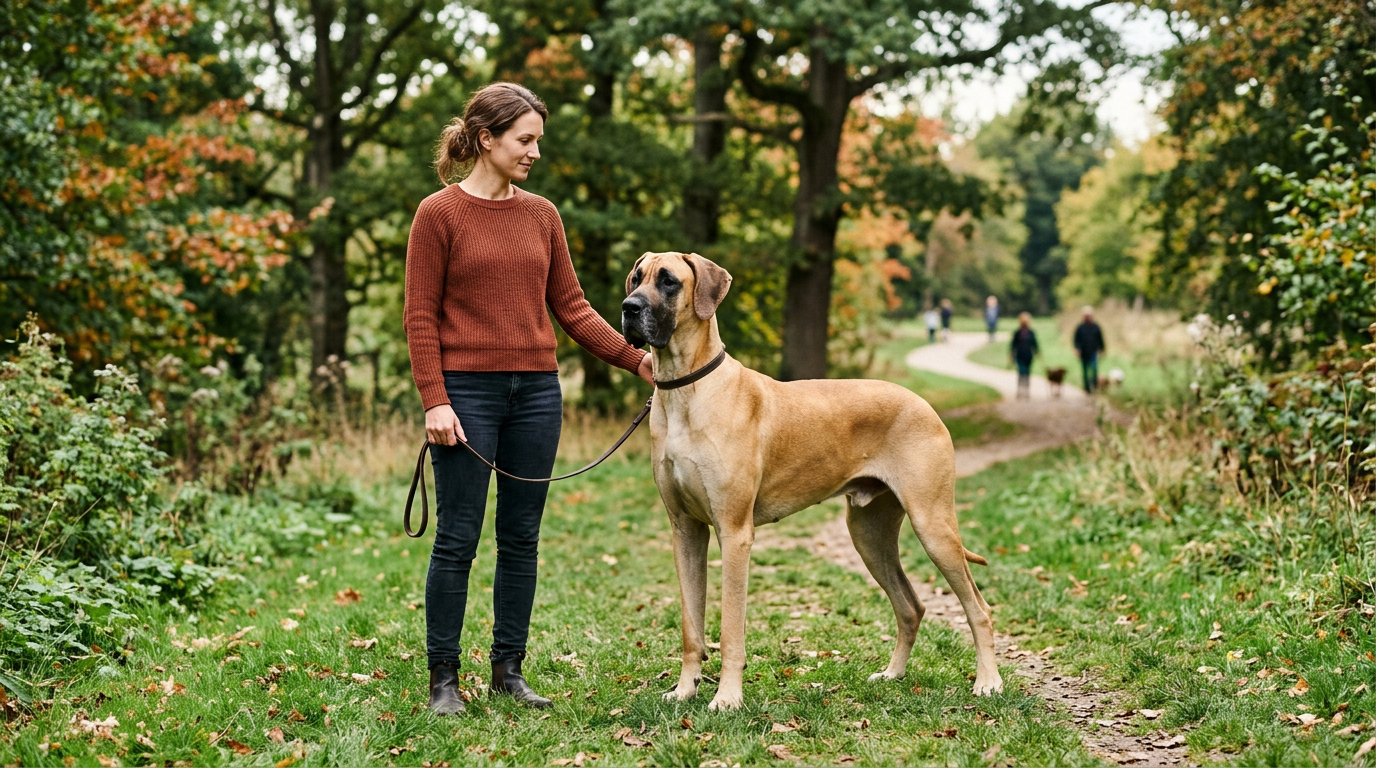
Great Dane breed guide research often starts with the breed’s height, but size is only the first practical issue. A Great Dane can be affectionate, steady and surprisingly relaxed indoors, yet every part of ownership happens on a giant scale. Food, beds, crates, medicines, veterinary procedures, transport and safe handling all cost more or require more space than they would for a medium dog. A well-bred, well-trained Dane can be an excellent companion; an undertrained one can knock over a child, drag an adult on lead or turn a routine vet visit into a logistical problem.
This guide explains what daily life with a Great Dane actually involves. It covers realistic size and lifespan, temperament, exercise, grooming, feeding, training, children, cats, apartment living, health screening and products that solve breed-specific problems. Use it to assess the ordinary Tuesday—not just the appealing puppy photos. Individual dogs vary, so combine breed knowledge with the temperament, health and history of the dog in front of you.
Great Dane ratings at a glance
| Category | Rating | What the score means |
|---|---|---|
| Family-friendly | 8/10 | Usually affectionate and people-oriented, but sheer size makes supervision, manners and household layout essential. |
| Exercise requirement | 6/10 | Adults need purposeful daily activity, though most are not relentless endurance dogs. Puppies require controlled, joint-conscious exercise. |
| Grooming requirement | 4/10 | The short coat is simple, but shedding, drool, nail care, dental care and handling a giant body add work. |
| Trainability | 7/10 | Many learn quickly with rewards and consistency. Training must begin early because physical management becomes difficult fast. |
These ratings are editorial planning tools, not guarantees. A calm adult rescue may fit an experienced family better than a high-energy puppy. Pain, poor socialisation, fear and genetics can change behaviour dramatically. Meet the dog more than once, ask direct questions and arrange an independent veterinary examination before making a commitment.
Breed overview
| Breed group | Working |
|---|---|
| Typical height | Males 30–32 inches; females 28–30 inches at the shoulder |
| Typical weight | Males 140–175 pounds; females 110–140 pounds |
| Typical lifespan | About 8–10 years |
| Coat | Short, smooth and moderately shedding |
| General character | Affectionate, social, watchful and usually composed when responsibly bred and raised |
| Best suited to | Owners with space, a giant-breed budget, consistent training habits and access to appropriate veterinary care |
The American Kennel Club lists males at 30–32 inches and 140–175 pounds, and females at 28–30 inches and 110–140 pounds. Dogs outside those ranges exist, and weight alone does not tell you whether a Dane is healthy. A visible waist, an abdominal tuck and ribs that can be felt without pressing hard are more useful than aiming for the heaviest number. Ask your veterinarian to score body condition at routine visits.
Great Danes developed from powerful European hunting and estate dogs. Modern companion lines should not behave like indiscriminate guard dogs. A stable Dane notices changes and may alert, but should be manageable in public and able to recover after a surprise. Extreme timidity, uncontrolled aggression and inability to settle are serious concerns, not traits to excuse as “protective.”
Size, weight and household logistics
A Great Dane’s footprint matters more than its shoulder measurement suggests. The dog needs enough floor space to turn without sweeping objects from tables, a bed long enough to support the spine and joints, and clear routes through doorways. Slippery flooring can undermine confidence and traction, especially for puppies and seniors. Place washable runners from the sleeping area to the garden, water bowl and main family room.
Measure before buying equipment. Many products labelled “large” are too short, too narrow or too lightly built for a Dane. A crate must allow the dog to stand naturally, turn and lie on its side, but a growing puppy may need a divider. Check the manufacturer’s internal dimensions and structural rating rather than relying on breed photos. Never leave a collar or harness attached inside a crate where it could snag.
Transport also deserves planning. A Dane may not fit safely on the back seat of a small car, and repeatedly jumping from a high cargo area can be hard on joints. Use a stable ramp, teach it gradually and secure the dog with a crash-tested restraint or suitable travel crate. Have an emergency plan for moving an injured dog: one adult may not be able to lift 60–80 kilograms without help.
Household rules should anticipate the adult dog. If the puppy will not be allowed on furniture at 70 kilograms, do not make the sofa its default bed at 12 weeks. Teach four paws on the floor, waiting at doors and settling on a mat from day one. Management gates must be tall and securely installed; lightweight pressure gates may be pushed over.
Lifespan and long-term planning
Great Danes commonly live about eight to ten years, although individuals may live shorter or longer lives. Their comparatively short lifespan is emotionally difficult and changes the financial timetable of ownership. Age-related joint disease, cardiac disease or cancer can appear while owners of smaller breeds still think of their dogs as middle-aged. Schedule preventive care consistently and investigate meaningful changes rather than attributing them automatically to “getting old.”
Track a baseline when the dog is well: appetite, resting breathing, normal gait, willingness to climb, body weight and typical sleep. A monthly video of walking and rising can help reveal gradual mobility changes. Ask the veterinarian when senior screening should begin for the individual dog. Early assessment can identify pain, weight change, dental disease and organ problems before they create a crisis.
Budget beyond routine vaccinations. Giant dogs use larger medication doses, require more staff for safe handling and may need specialist imaging or emergency surgery. Insurance terms, exclusions and reimbursement limits should be reviewed before illness appears. If self-funding, maintain a dedicated emergency reserve large enough for out-of-hours assessment and major surgery, not only an annual check-up.
Great Dane temperament
This Great Dane breed guide treats temperament as a practical management issue: owners need a dog that can settle, accept handling and move safely through ordinary public spaces.
A typical well-adjusted Great Dane is close to its people and often wants physical contact. Many lean, sit on feet or attempt to occupy laps. That sociability can be charming, but it can also develop into distress when left alone if independence is never practised. Build short, calm absences from puppyhood and vary the routine so departures do not predict panic.
Danes often look imposing without needing to act aggressively. Good temperament includes the ability to observe strangers without lunging, accept routine handling and disengage when asked. Socialisation does not mean forcing greetings with everyone. It means teaching the dog to function safely around people, dogs, traffic, surfaces, noises and veterinary procedures while preserving choice and distance.
Adolescence can be challenging. A young Dane may combine an adult-sized body with puppy impulse control, become wary of unfamiliar objects or test learned boundaries. Continue rewards-based training through physical maturity. Reduce difficulty temporarily after a frightening event, and seek a qualified behaviour professional early if fear, guarding or reactivity is increasing.
Some Danes are playful with dogs; others become selective as adults. Avoid chaotic dog parks where collisions, bullying and uncontrolled chase can cause injury. Choose compatible, known play partners and interrupt before arousal becomes frantic. Parallel walks are often a better introduction than face-to-face pressure.
Exercise requirements
An adult Great Dane usually needs daily walks, sniffing, training and free movement in a secure area. Many do well with two purposeful outings rather than one exhausting session. Duration depends on age, health, weather, pace and surface. The useful question is whether the dog returns pleasantly tired and can settle, not whether a universal minute target has been reached.
Mental work prevents owners from trying to solve every problem with mileage. Scatter part of a meal in grass, practise scent searches, rotate safe food puzzles and include brief obedience exercises on walks. Five minutes of focused lead work or nose work can be more productive than repeatedly throwing a ball at high speed.
Great Dane puppies grow rapidly. Avoid repetitive forced running, long roadwork beside a bicycle, frequent high jumping and uncontrolled pounding on hard surfaces. This does not mean confinement. Puppies need free movement, varied surfaces, play, exploration and gradual muscle development. Ask the puppy’s veterinarian for an individual plan based on growth, body condition and orthopaedic health; the popular “five minutes per month of age” rule is not a medical prescription.
Warm weather requires caution. Exercise early or late, bring water and choose shaded routes. Heavy panting that does not settle, weakness, disorientation, vomiting or collapse requires urgent cooling and veterinary help. In cold or wet conditions, some short-coated Danes benefit from a well-fitted coat, particularly seniors or lean dogs, but exercise should still be adjusted to footing and comfort.
After meals, keep activity calm and follow the veterinarian’s advice about feeding schedules and GDV risk. Avoid turning mealtime into a race followed by hard play. If a dog gulps food, use an appropriately designed slow feeder or divide the ration into smaller meals while ensuring the setup does not create frustration.
Grooming and routine care
The short coat is low-maintenance but not no-maintenance. Brush once or twice weekly with a rubber grooming mitt or soft bristle brush to collect loose hair and inspect the skin. During heavier shedding, a few brief sessions are more comfortable than aggressive scraping. Bathe when dirty with a dog shampoo, rinse completely and dry skin folds around the lips and neck.
Nails are a major practical issue. Overgrown nails alter footing, reduce traction and make a giant dog harder to move comfortably. Introduce a grinder or clippers in tiny steps: touch the paw, reward; hold a toe, reward; switch the tool on at a distance, reward. Trim small amounts frequently. If nails are already long or the dog is fearful, ask a veterinarian, groomer or force-free trainer for a staged plan.
Check ears weekly for redness, debris, odour or discomfort. Clean only with a veterinary-approved product and never push cotton buds into the canal. Recurrent ear trouble needs diagnosis because allergies, infection or foreign material will not be fixed by repeated surface cleaning. Inspect eyes for persistent redness, cloudiness, discharge or squinting and seek veterinary care promptly for painful changes.
Dental care matters even in a short-lived giant breed. Brush daily where possible with dog toothpaste; human toothpaste is inappropriate. Start by pairing lip handling with food, then build to a finger brush and toothbrush. Dental chews can supplement brushing if they are safe for the dog’s chewing style and calories are included in the daily ration.
Drool varies by individual but is part of life with many Danes. Keep washable cloths near water stations and protect walls or furniture where the dog shakes its head. Sudden excessive drooling, repeated swallowing or retching is not merely a housekeeping issue; combined with restlessness or abdominal enlargement it can signal an emergency.
Feeding a Great Dane
Feed a complete and balanced diet appropriate for life stage. Great Dane puppies should receive a food formulated for growth of large-size dogs, with mineral and energy levels designed for controlled growth. Faster is not better. Excess calories can create an overweight puppy and increase stress on developing joints. Do not add calcium, vitamins or homemade supplements unless a veterinarian or board-certified veterinary nutritionist has assessed the entire diet.
Measure portions rather than filling the bowl by eye. Start with the manufacturer’s guide, then adjust according to body condition, weight trend, treats, neuter status and activity. Weigh a growing puppy regularly and record the result. If the waist disappears or ribs become difficult to feel, discuss a modest adjustment rather than waiting for obvious obesity.
Divide the daily ration into multiple meals, particularly for puppies. Keep training treats small and deduct substantial extras from meals. Family members should use one shared treat container so the dog is not fed repeatedly by different people. Rich scraps can cause gastrointestinal upset and undermine a carefully balanced diet.
Change food gradually over several days unless the veterinarian directs otherwise. Persistent diarrhoea, repeated vomiting, poor appetite, weight loss or a swollen abdomen needs veterinary attention. A Great Dane puppy that is not eating or is acutely painful should not be managed through repeated internet diet changes.
Fresh water should always be accessible. Choose stable bowls that cannot be easily tipped and place an absorbent mat underneath. Evidence does not support automatically raising bowls as a GDV-prevention measure; Cornell lists raised bowls among possible risk factors. Make bowl height and feeding decisions with the dog’s veterinarian rather than following breed folklore.
GDV: the emergency every owner must recognise
Gastric dilatation-volvulus, commonly called GDV or bloat, is a life-threatening emergency in which the stomach distends and twists. Great Danes are among the highest-risk breeds because of their large, deep-chested build. This is not a condition to monitor at home. Survival depends on rapid veterinary stabilisation and surgery.
Warning signs can include repeated unproductive retching, a swollen or tight abdomen, pacing, inability to settle, excessive drooling, weakness, pale gums, rapid breathing or collapse. The abdomen is not always obviously enlarged early. If several signs appear, call the nearest emergency hospital while leaving and state that you suspect GDV. Do not wait for a regular appointment, give home remedies or attempt to make the dog vomit.
Save the emergency hospital’s phone number and route in every household member’s phone. Confirm in advance which clinic can handle giant dogs overnight. Keep a transport ramp and lead accessible. A written plan matters because people lose time searching when frightened.
Discuss prophylactic gastropexy with the veterinarian well before an emergency. The procedure attaches the stomach to the abdominal wall and greatly reduces the risk of twisting, although the stomach may still dilate and the dog can still need urgent care. Timing, surgical approach, benefits and risks are individual medical decisions. Some owners discuss performing it during another planned anaesthetic.
Risk reduction is not a guarantee. Smaller divided meals, slower eating and calm routines around food may be discussed with the veterinarian, but no household routine eliminates GDV. Knowing the signs and having immediate access to emergency care are essential parts of responsible Dane ownership.
Common health considerations
Cardiac disease
Great Danes can develop heart disease, including dilated cardiomyopathy. Possible signs include reduced stamina, coughing, weakness, fainting, rapid or laboured breathing and abdominal swelling, although early disease may be silent. The Great Dane Club of America recommends cardiac screening for breeding dogs and notes that echocardiograms are particularly important. A normal young-adult result is useful but does not guarantee lifelong cardiac health.
Hip and joint disease
Hip dysplasia, osteoarthritis and other mobility problems can affect comfort. Maintain a lean body condition, provide traction, build fitness gradually and investigate persistent lameness. A dog that hesitates to rise, shortens its stride or stops using stairs may be painful even if it never cries. Do not give human painkillers; several are toxic to dogs.
Thyroid and eye concerns
The parent club includes thyroid and eye evaluations in its minimum screening recommendations for breeding stock. Thyroid disease can produce varied signs, so diagnosis requires veterinary assessment rather than guessing from coat or weight changes. Eye pain, sudden cloudiness, vision loss or persistent squinting deserves prompt examination.
Cervical and neurological problems
Large, long-necked breeds can experience cervical spinal disease, sometimes described as wobbler syndrome. An unsteady gait, dragging toes, neck pain, weakness or difficulty rising requires veterinary evaluation. Use a harness for controlled assistance if advised, but do not delay diagnosis or attempt forceful neck manipulation.
Bone disease during growth
Rapidly growing puppies can develop painful orthopaedic conditions such as panosteitis or hypertrophic osteodystrophy. Fever, marked pain, reluctance to move or unexplained lameness is not normal “growing pain.” Arrange veterinary assessment. Nutrition should support controlled growth, but changing minerals without professional direction can make the diet less safe.
Other illnesses occur, including cancer, skin disease, dental disease and reproductive emergencies. Breed risk should sharpen observation, not replace veterinary diagnosis. Seek urgent care for breathing difficulty, collapse, severe pain, repeated vomiting, abdominal swelling, inability to urinate, major trauma or sudden neurological change.
Health testing and choosing a breeder
The Great Dane Club of America recommends baseline normal hip, heart, thyroid and eye results for breeding dogs at about two years of age, with heart and thyroid testing repeated every two to three years. Ask for the registered names of both parents and verify results in the OFA database. A screenshot, “vet checked” claim or DNA panel alone is not equivalent to the complete recommended screening.
Responsible breeders discuss both strengths and problems in their lines. Ask about longevity, GDV, cardiac disease, temperament, orthopaedic disease and causes of death among close relatives. They should raise puppies in a clean, enriched environment, match temperaments to homes, provide a contract and take back a dog they bred if the owner can no longer keep it.
Be cautious if a seller always has puppies, markets unusual colour as the main reason for a high price, refuses home or video visits, cannot show objective test results or pressures for immediate payment. A puppy’s parents being “healthy so far” is not screening. Neither registration nor a pedigree proves that recommended tests were completed.
Rescue can be an excellent route. Ask for veterinary records, behaviour observations, bite history, dog and cat assessments, response to being left, lead manners and any medication. Foster-home information is often more useful than a brief shelter observation. Arrange a realistic transition plan and use gates, routine and low-pressure introductions during the first weeks.
Training a Great Dane
Training is not optional when a dog can outweigh many adults. Start with name response, hand target, loose-lead walking, recall, wait, drop, leave, mat settle and cooperative handling. Practise in quiet places first, then add distance and distraction one variable at a time. Reward the behaviour you want before the dog rehearses pulling, jumping or barging.
Use a fixed-length lead and comfortable, well-fitted harness for routine walks. Retractable leads offer little control around traffic and can create dangerous momentum. Equipment does not teach walking skills; reward slack lead frequently, change direction before pulling becomes powerful and choose routes where the dog can succeed.
For greetings, ask visitors to ignore the dog until four paws are on the floor. A gate or lead prevents rehearsal. Reward standing calmly or going to a mat, then release for a brief greeting if everyone is comfortable. Do not use kneeing, shouting or lead jerks. Physical confrontation can create fear and is unnecessary.
Teach door manners with staged practice. Approach the door, reward a pause, touch the handle, reward, open it a crack and close it if the dog surges. Progress until the dog waits for a release cue. This single skill reduces escapes, collisions and frightening encounters with delivery workers.
Cooperative care saves stress. Teach chin-rest, paw presentation, standing on a nonslip mat and calmly accepting ear, mouth and body checks. Introduce a basket muzzle positively even if the dog is friendly; pain or emergency treatment can change behaviour, and a trained dog can receive safer care.
Short sessions work best. End after a useful success and integrate training into meals, doors and walks. If the dog freezes, avoids, growls or repeatedly fails, reduce difficulty. Growling is information, not disobedience to punish. Consult a credentialed reward-based professional for fear, guarding, separation distress or aggression.
Are Great Danes good with children?
Many Great Danes are gentle and affectionate with children, earning an 8/10 family rating here. Size remains the central risk. A friendly tail can strike a toddler, a playful body check can cause injury and a child cannot physically control an adolescent Dane. Adults must actively supervise; being in the same room while looking at a phone is not enough.
Give the dog a child-free bed or gated room. Children should not climb on the dog, take food, hug tightly, approach while sleeping or interfere with a chew. Teach them to call an adult if the dog has something forbidden. Feed behind a barrier and separate during high-energy play, parties or visiting children.
Watch for subtle stress: head turning, lip licking, yawning, freezing, moving away, a closed tense mouth or showing the whites of the eyes. End the interaction before a growl or snap. A dog that repeatedly avoids children is asking for distance, not more exposure.
Are Great Danes good with cats and other pets?
Some Danes live peacefully with cats, particularly when raised with them, but prey drive and chase behaviour vary. A history of calm cat living is more informative than breed reputation. Introduce through barriers, keep the dog on lead initially and reward looking away from the cat. The cat needs high escape routes, dog-free rooms and separate food and litter areas.
Do not allow “playful” chasing. Each chase strengthens the pattern and can end badly because of the size difference. Progress only when both animals eat, rest and move normally in the other’s presence. If the dog stalks, trembles, fixates or cannot disengage, obtain professional help and maintain separation.
With dogs, match play style and physical robustness. A Dane can accidentally injure a small dog even without aggression. Feed separately, manage valuable chews and give each animal private rest. Same-sex conflict or adult dog selectivity can occur, so introductions should not rely on a single quick greeting.
Apartment suitability
A Great Dane can live in a spacious apartment if exercise, toilet access, lifts, noise and emergency logistics are managed. Indoor energy is often moderate, but the physical footprint is enormous. Narrow hallways, steep communal stairs and a tiny lift may make daily life impractical. Check lease, weight limits, insurance and body-corporate rules before committing.
Consider what happens when the lift fails or the dog cannot use stairs after surgery. A ground-floor exit is valuable. Frequent puppy toilet trips are harder from a high floor, and carrying the puppy becomes impossible quickly. Neighbours may hear deep alert barking or heavy movement, so teach settling and reduce visual triggers.
A yard does not automatically make a home suitable, and no yard does not automatically rule it out. Access to safe walking routes, traction indoors, cooling and enough space to rest without blocking traffic are more important. Leaving a Dane alone on a balcony or in a small courtyard does not meet its social and exercise needs.
Similar breeds to consider
| Breed | Why compare | Key difference |
|---|---|---|
| Mastiff | Giant, generally calm and devoted | Usually heavier, with different guarding and drool considerations |
| Irish Wolfhound | Very tall, gentle and companionable | Rough coat and stronger sighthound heritage |
| Newfoundland | Large, family-oriented and trainable | Heavy coat, water-dog instincts and greater grooming demand |
| Saint Bernard | Giant, steady family companion | Heavier coat or shedding and significant heat sensitivity |
| Boxer | People-focused, expressive and athletic | Smaller but often more energetic and exuberant |
Do not choose by appearance alone. Compare adult energy, lifespan, health risks, prey drive, guarding tendency, grooming, climate tolerance and the largest likely veterinary bill. Meeting mature dogs is far more informative than meeting only puppies.
Recommended Great Dane products
| Product | Best for | Rating | Buying note |
|---|---|---|---|
| Large-breed growth dog food | Great Dane puppies | 10/10 | Choose a complete food labelled for growth including growth of large-size dogs; confirm with your veterinarian. |
| Supportive giant dog bed | Joints and sleep | 9/10 | Look for dense, replaceable foam, a waterproof liner and washable cover. |
| Nonslip floor runners | Traction | 9/10 | Use rubber-backed washable runners on routes the dog uses daily. |
| Fixed-length lead | Controlled walking | 9/10 | Choose strong hardware and a comfortable handle; inspect stitching frequently. |
| Well-fitted Y-front harness | Everyday walks | 9/10 | Allow free shoulder movement and recheck fit as a puppy grows. |
| Stable vehicle ramp | Car access | 8/10 | Check width, surface grip and maximum rated load. |
| Rubber grooming mitt | Short-coat shedding | 8/10 | Use gentle pressure and stop if skin becomes irritated. |
| Slow feeder | Dogs that gulp meals | 8/10 | Select wide, easy-to-clean grooves that slow rather than frustrate. |
| Extra-large food puzzle | Enrichment | 8/10 | Avoid pieces the dog could swallow; supervise and replace damaged items. |
| Basket muzzle | Cooperative safety training | 8/10 | It must permit panting, drinking and treats; condition it gradually. |
Affiliate links should be disclosed clearly when added. Ratings above reflect usefulness for the breed, not a warranty for a particular brand. Confirm dimensions, weight limits and return policies. Inspect every item for wear, especially leads, harnesses, gates, ramps and food toys.
First-month setup
Before arrival, choose a veterinarian, locate a 24-hour emergency hospital and ask whether it regularly treats giant breeds. Buy only immediately necessary equipment because puppies outgrow harnesses and beds quickly. Install runners, gates and a rest area; remove unstable furniture and food hazards from tail and nose height.
During the first week, keep life predictable. Use the same food initially, schedule toilet trips, allow generous sleep and introduce visitors slowly. Begin rewarding the name, following, calm collar handling and settling. Avoid a parade of crowded outings. Quality experiences at a comfortable distance are more valuable than maximum exposure.
Book a veterinary examination and bring all records. Discuss vaccination, parasites, nutrition, body condition, growth, gastropexy, insurance, dental care and emergency signs. For an adult rescue, ask about pain and mobility as well as behaviour; untreated discomfort can look like stubbornness, reluctance or irritability.
Daily and weekly care checklist
- Provide measured meals and fresh water.
- Check appetite, stool, gait and general comfort.
- Give age-appropriate walking, sniffing, play and training.
- Practise a calm settle and a brief period of independence.
- Inspect paws and remove debris after walks.
- Brush the coat and inspect skin once or twice weekly.
- Check ears, eyes, mouth and nails weekly.
- Wash bedding and clean feeding equipment regularly.
- Review weight and body condition monthly.
- Recheck harness fit and equipment wear as the dog grows.
A checklist should support observation, not create false reassurance. A Dane that is retching, collapsing, struggling to breathe or showing a distended abdomen needs emergency care regardless of when the last routine check was completed.
Is a Great Dane right for you?
A Great Dane may suit you if you want a close companion, can train consistently, have enough physical space and can fund giant-breed food and veterinary care. You should be comfortable managing drool, shedding, an imposing public presence and a dog that may weigh as much as an adult person. Reliable transport and emergency access are essential.
Choose another breed if you need a low-cost dog, cannot control access between dogs and small children, live where weight rules prohibit the breed or expect a yard to replace daily interaction. A Dane is also a poor match for anyone unwilling to practise lead manners and calm greetings before the puppy becomes powerful.
The best decision is often made after spending time with several adults, talking candidly with experienced owners and pricing actual local services. Calculate food, preventive medication, boarding, equipment, insurance and emergency care using giant-dog rates. Then decide whether the commitment remains comfortable.
Conclusion
A responsible Great Dane breed guide must look beyond the breed’s dramatic height. The defining ownership tasks are controlled growth, early manners, traction, safe transport, a realistic budget and preparation for GDV and cardiac risk. Meet those needs and many Danes become affectionate, composed companions who fit deeply into family life.
Before bringing one home, verify health testing, evaluate the individual temperament, prepare the house and confirm access to giant-breed veterinary care. Keep training practical and rewards-based, maintain a lean body condition and know the emergency signs. Those specific preparations matter more than any claim that the breed is automatically a “gentle giant.”
Related breed guides
Compare the Great Dane with the Bernese Mountain Dog breed guide and Boxer breed guide when weighing size, exercise and family life. For smaller-home considerations, use our guide to dog breeds for apartment living.
Does this breed fit your life?
Use the dog lifestyle quiz to compare this breed with your home and routine, browse the breed database, or compare breeds side by side before deciding.