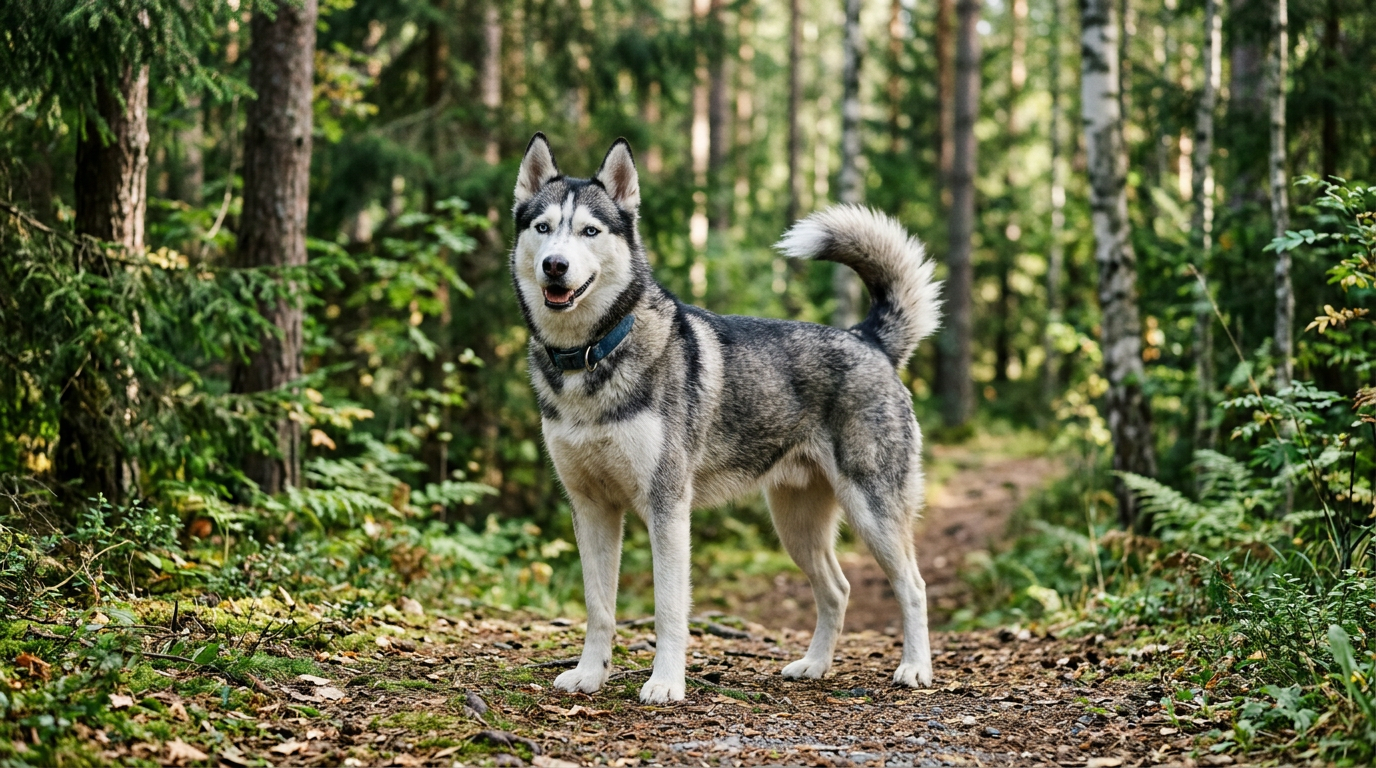
A Siberian Husky is an endurance sled dog wrapped in an eye-catching double coat. This Siberian Husky breed guide explains the practical reality behind the appearance: secure containment, significant daily activity, careful heat decisions, heavy seasonal shedding and realistic management of prey drive. The breed can be social and entertaining, but it is a demanding match.
A large yard alone is not the answer. A bored Husky can dig, climb, squeeze through a gap or run when a gate is opened. The right owner plans shared exercise and training, checks boundaries regularly and accepts that off-lead freedom may need to happen only in securely enclosed spaces.
Siberian Husky ratings
These are editorial suitability ratings, not scientific scores or guarantees about an individual dog. Higher family and trainability scores indicate an easier fit. Higher exercise and grooming scores indicate more owner effort.
| Trait | Rating | Practical meaning |
|---|---|---|
| Family-friendly | 8/10 | Often sociable and playful, but size, speed and exuberance require supervision. |
| Exercise requirement | 10/10 | Needs substantial purposeful activity and mental engagement every day. |
| Grooming requirement | 8/10 | The double coat sheds heavily, especially when the undercoat releases. |
| Trainability | 7/10 | Intelligent and capable, but independence and strong environmental rewards raise the difficulty. |
Breed overview
| Breed | Siberian Husky |
|---|---|
| Origin and purpose | Northeast Asian sled dog developed for efficient endurance work in a team |
| Group | Working breed |
| Male size reference | 21–23.5 inches (53–60 cm); 45–60 lb (20–27 kg) |
| Female size reference | 20–22 inches (51–56 cm); 35–50 lb (16–23 kg) |
| Lifespan reference | 12–14 years |
| Coat | Dense double coat with a soft undercoat and straighter protective outer coat |
| Daily priorities | Secure exercise, recall management, coat care, companionship and recovery |
| Best fit | Active owners prepared for containment, shedding and independent decision-making |
The size ranges follow the Siberian Husky Club of America breed standard. A Husky is lighter and more moderate than many people expect from photographs. Breed limits are not individual target weights; ask a veterinarian to assess body and muscle condition.
Size and weight
A Husky is a medium-sized but powerful dog. Its pulling ability and quick acceleration make equipment strength and handler skill important. Measure chest, neck and back length before buying a harness. Check that the dog cannot reverse out and that straps allow free shoulder movement.
Use a body-condition assessment as well as scales. The dense coat can hide ribs, waist and muscle loss. Weigh under similar conditions, record trends and reassess food when workload changes.
Do not select a puppy for extreme size, unusual eye colour or an exaggerated “wolf-like” look. Ask about health, temperament, parent size and working soundness. Terms such as giant, miniature or woolly may describe marketing or coat variation rather than a separate recognised breed.
Lifespan and long-term planning
A planning range of roughly 12–14 years turns secure fencing, veterinary care and exercise into long-term expenses. Consider how you would care for the dog if your running habits, housing or work schedule change. Identify backup walkers or carers who can manage the equipment and escape risk.
Teach skills before they are urgently needed: calm vehicle entry, wearing a harness, standing for body checks, resting behind a gate and returning through an open doorway on cue. A senior dog can learn, but familiar routines reduce stress.
As the dog ages, maintain comfortable movement and scent-based engagement while adjusting speed and distance. New stiffness, scuffing feet, altered vision, night waking or reluctance to exercise needs assessment rather than an assumption that age explains everything.
Temperament and daily life
Many Siberians are sociable with people and enjoy canine company. Their openness means they are not automatically effective guard dogs. They may vocalise, watch and investigate without showing the territorial behaviour some owners expect.
Independence is not a lack of intelligence. A Husky may understand a cue and still find running or scent more rewarding in that moment. Build value through rewards and manage the environment instead of escalating force.
Vocal behaviour ranges from quiet to dramatic howling, whining or “talking”. Decide what is acceptable and reinforce calmer alternatives. Sudden or persistent vocal change can reflect discomfort or distress and deserves investigation.
Secure containment
Inspect fencing from the dog’s level. Look for gaps, loose boards, diggable edges, climbable objects and latches that can be nudged. Gates should close reliably and visitors need clear instructions. Consider an airlock arrangement at frequently used entrances.
Never leave a Husky tethered unsupervised. Tethers can cause injury and do not resolve escape motivation. Likewise, electronic boundary systems do not provide a physical barrier against wildlife, traffic or theft.
Check after storms, gardening or contractor visits. Containment is a system, not a one-time purchase. Identification and microchip details should remain current in case the system fails.
Exercise requirements
Healthy adult Huskies need substantial daily movement, but the correct programme depends on age, conditioning, climate and medical history. Combine aerobic work, sniffing, training and recovery. A fixed two-hour rule is less useful than observing the actual dog.
Build fitness gradually. Weekday inactivity followed by a long weekend run increases risk. Start sessions with controlled movement, increase distance or resistance in small increments and cool down afterwards.
Suitable activities
Walking, hiking, scent work and structured pulling sports can all suit the breed. Running beside a person may suit a conditioned adult after veterinary clearance. Dog-powered sports require correct harnesses, cues, surfaces and instruction from an experienced club.
Do not attach a pulling dog to unsuitable equipment or a child. Brakes, line length, trail etiquette and passing other teams are safety skills. Begin on foot with directional and stop cues before adding speed.
Puppies and adolescents
Puppies need short self-paced exploration, play and sleep rather than forced distance. Avoid repetitive jumping and sustained running on hard surfaces. Ask the vet about safe exposure before vaccinations are complete.
Adolescence produces adult speed before adult judgement. Use a long line in suitable open areas, secure fields and barriers. Do not “test” recall beside livestock, roads or wildlife to see whether training worked.
Heat management
A Husky can overheat. Exercise during cooler periods, use shade and water, and avoid hot pavement. Humidity reduces the effectiveness of panting. A dog that wants to continue is not necessarily safe to do so.
Heavy panting that does not ease, weakness, confusion, vomiting or collapse requires urgent veterinary attention. Move to a cooler area, contact a clinic and follow professional instructions. Do not delay travel while trying multiple home remedies.
Recovery and rest
Teach an end-of-activity routine: cool down, water, a quiet space and calm occupation. A dog unable to settle after intense exercise may need lower arousal, better recovery or assessment for pain—not automatically another run.
Provide undisturbed sleep. In a multi-dog home, separate resting spaces and food activities prevent constant social pressure. Rest is part of fitness, not a sign that a high-energy dog is being neglected.
Building a sustainable weekly routine
A useful Siberian Husky breed guide must account for ordinary weekdays. A healthy adult might start with a substantial cool-weather walk that includes sniffing and loose-lead practice, then rest after breakfast. A later session can focus on controlled running, pulling-sport foundations or secure-field movement, followed by a cool-down.
Not every day should be a speed day. Alternate aerobic work with longer sniff walks, scent searches and technique sessions. Include easier recovery days after hard activity. This creates fitness without making ever-higher intensity the only route to satisfaction.
Bad-weather alternatives
In heat, replace daytime exertion with brief toilet trips and indoor work, then use cooler hours for outdoor movement. Hide food around a room, practise finding named toys or lay a simple scent trail. Keep floors non-slip and tasks achievable.
During storms or smoke events, use the same approach and follow local safety advice. Indoor mental work is a temporary adjustment, not a permanent replacement for exercise. Identify a safe covered facility or professional service before it is needed.
When the dog cannot exercise normally
Injury recovery can be difficult for an active Husky. Follow the veterinarian’s restrictions exactly and ask which enrichment is permitted. Stationary scent work, food puzzles or calm handling may still exceed restrictions after some procedures.
Prevent door dashes and sudden play with barriers and leads. If frustration rises, ask the treating team or a qualified trainer for a plan that respects medical limits. Do not secretly add activity because the dog appears energetic.
Grooming and shedding
The double coat releases hair all year and often sheds undercoat heavily during seasonal changes. Brushing removes loose hair and helps inspect skin, but it will not produce a shed-free home. Owners should expect hair on floors, clothes and furniture.
Brushing routine
Work in sections on a stable, non-slip surface. Use tools recommended for a double coat and confirm they reach loose undercoat without scraping skin or cutting healthy guard hairs. Check behind ears, under the collar, along the thighs and around the tail.
During a coat blow, short daily sessions are often easier than one prolonged struggle. A professional groomer may use bathing and controlled drying to release undercoat. Introduce the dog to sound and airflow gradually.
Do not use aggressive de-shedding tools until you understand how they affect the coat. Stop if skin reddens, hair breaks or the dog repeatedly flinches. A groomer can demonstrate technique.
Bathing and shaving
Bathe when dirty using a dog-appropriate product, rinse thoroughly and dry the dense undercoat. Persistent odour, greasy skin, bald areas or itching needs veterinary assessment.
Routine shaving is not a substitute for heat management or brushing. Discuss any major clip with a veterinarian and experienced groomer, especially when surgery, severe matting or skin disease is involved. Provide cool surroundings and sensible activity rather than relying on coat removal.
Nails, feet, ears and teeth
Keep nails maintained for traction and comfortable gait. Snow, ice, grit and hot surfaces can affect paw pads; inspect after outings. Trim excess hair only as advised and avoid products the dog can lick without safety guidance.
Check ears for redness, pain, odour or discharge without inserting cotton buds. Brush teeth with dog toothpaste as instructed by the veterinary team. Grooming should be cooperative care, built through brief rewarded steps.
Feeding
Feed a complete diet suitable for life stage and actual workload. Measure the full daily allocation and count treats, chews and training food. A sled athlete, a weekend hiker and a recovering pet may have very different energy needs despite sharing a breed.
The WSAVA nutrition guidelines include tools for selecting foods and assessing body and muscle condition. Marketing terms such as “ancestral” do not establish nutritional adequacy.
Workload and portions
Record activity alongside weight and food. If training volume changes, review portions gradually with veterinary guidance. Do not judge intake only by appetite; many dogs will accept more food than they need.
Use part of meals as training rewards. In a multi-dog home, feed separately and confirm each dog consumed its own portion. Secure food storage against an animal capable of opening doors or bins.
Puppies and seniors
Choose a complete growth food appropriate to expected adult size and follow veterinary advice on meal frequency. Do not add calcium or performance supplements without a specific recommendation.
Older dogs may need different energy intake while still requiring adequate protein and nutrients. Monitor muscle as well as fat. A stable scale number can conceal muscle loss and fat gain.
Common health considerations
This information helps prepare questions; it does not diagnose a dog. The Siberian Husky Club of America’s health statement, approved on September 10, 2024, specifies annual eye examination, hip evaluation and DNA tests for SPS1 and SHPN1 in breeding dogs.
Hip dysplasia
Hip dysplasia involves abnormal hip development and may contribute to pain or arthritis. Request identifiable hip results for both parents through OFA, PennHIP or another recognised registry accepted under the current breed-club guidance.
In a pet, stiffness, lameness, reduced stride or reluctance to rise needs assessment. Management is individual and may include body-weight control, suitable activity, rehabilitation, medication or surgery. Never give human pain medication unless a veterinarian directs it.
Eye disease
The club calls for annual specialist eye examination in breeding stock from at least 12 months, with results registered through SHOR or OFA CAER. Ask for current reports; an old clearance does not meet an annual schedule.
Squinting, redness, cloudiness, discharge, a painful eye or sudden navigation change needs prompt veterinary care. Night hesitation can be subtle. Do not use leftover eye drops because treatments differ and some can worsen specific conditions.
Shaking Puppy Syndrome Type 1
SPS1 is an inherited neurologic condition for which DNA testing is available. The SHCA SPS1 guidance explains that testing can identify clear, carrier and affected dogs and should inform pairings. A carrier is not the same as an affected dog.
Ask to see reports for both parents and how the results were used. The club cautions against removing all carriers from breeding because genetic diversity matters; carriers can be paired with clear dogs under its guidance.
Siberian Husky Polyneuropathy Type 1
SHPN1 is another condition with breed-specific DNA testing. The SHCA SHPN1 page recommends testing breeding dogs for both SHPN1 and SPS1. Request the exact reports rather than a general statement that a broad panel was normal.
A pet with weakness, an abnormal gait, exercise intolerance or neurologic signs needs clinical investigation. A DNA result may inform diagnosis but does not replace examination.
Skin and coat changes
Persistent scaling, crusting, hair loss or itching should be assessed. Avoid assuming every Husky skin problem is a zinc issue or adding supplements without testing and dosing guidance. Excess minerals can cause harm.
Parasite risks depend on location and travel. Discuss prevention with a local veterinarian and use products for the correct species and current weight. Check the dog after outdoor activity, particularly in tick areas.
Health screening before buying
Use the SHCA health statement as a checklist. Verify hips, current eyes, SPS1 and SHPN1. Ask about longevity, seizures, skin disease, movement and temperament in close relatives.
Read dates, dog identifiers and results. A health guarantee is not a substitute for screening, and no screening eliminates every risk. Observe adult dogs for comfortable movement, stable social behaviour and recovery after activity.
Read the contract before payment. It should identify the dog and parties, document relevant health information and explain return arrangements. Avoid sellers who emphasise rare colours or eye combinations while dismissing containment, temperament and tests.
Training a Siberian Husky
Use reward-based methods and strong management. A Husky learns from outcomes: if pulling reaches a smell or a dash through the door produces freedom, those behaviours have paid. Prevent dangerous rehearsal and reinforce the alternative before the dog is fully committed.
Foundation skills
Prioritise name response, recall, loose-lead walking, waiting at doors, object exchange, mat settling and cooperative handling. Practise each in a quiet place before adding distance or distraction.
Keep sessions short and purposeful. Food, toys, movement and permission to sniff can all reward behaviour. End while the dog remains engaged rather than drilling until it disengages.
Door and gate safety
Use two barriers while training if an exterior door opens onto an unsafe area. Teach the dog to move to a mat or wait behind a line before the handle turns. Practise with no visitor present.
For deliveries, secure the dog first. Do not rely on a verbal stay while carrying parcels or talking to someone. Every resident and visitor needs the same gate rule.
Recall
Begin indoors, then in a secure yard and later on a long line in a suitable open space. Say the cue once, move away and reward generously. Sometimes release the dog to explore again so returning does not always end access.
Off-lead freedom outside secure fencing may never be an acceptable risk for an individual with strong chase drive. Training improves response; it cannot remove roads, wildlife or genetics. Use securely fenced fields or dog-sport settings for safe running.
Loose-lead walking and pulling sports
Clearly separate ordinary walking from harnessed pulling. Use different equipment and cues. During a normal walk, reward slack and pause when the lead tightens. Include sniff breaks so the outing is not a continuous formal heel.
Learn pulling sports through a suitable club. Correct fit, directional cues, trail surfaces, temperatures and stopping ability matter. Do not improvise by allowing a dog to tow an uncontrolled wheeled object.
Digging and destructive behaviour
Block access to vulnerable fence edges and do not leave the dog outside unattended. A permitted digging area can provide an outlet if taught and maintained. Indoors, rotate safe activities and make rest predictable.
Destruction during absence can be boredom, lack of management or separation distress. Observe what happens. Panic, drooling or escape attempts need professional assessment rather than a stronger crate.
Good with children?
Many Huskies are playful and sociable with children, but active supervision is essential. Speed and body contact can knock a child down. Separate the dog during running games, parties and times when adults cannot watch.
Teach children not to hug, climb on, chase or disturb the dog while eating or sleeping. Give the dog a child-free resting area. Children should call an adult if the dog has a valued or unsafe object.
Shared activities can include supervised food searches or simple cues. Adults handle leads, doors and conflict. Growling, freezing or avoidance signals discomfort and should prompt separation and qualified guidance, not punishment.
Good with cats and other pets?
Huskies can have strong prey drive. Some live with cats after careful introductions; others are unsafe. Previous peaceful contact does not guarantee behaviour in every context, especially outdoors or when an animal runs.
Use separate zones, secure barriers and a lead for early introductions. Reward the dog for disengaging and give the cat high routes, food, water and litter access without passing the dog. Never force contact.
Small mammals and birds require secure physical separation, preferably behind two barriers. Do not allow “supervised play”. A fast predatory sequence can develop before a person can intervene.
Many Huskies enjoy dog company, but match play style and provide breaks. Feed separately and manage toys. Introduce one-to-one rather than relying on a crowded off-lead area.
Apartment suitability
A Siberian Husky is a challenging apartment dog. It may work for an experienced, highly active household with excellent noise and exercise planning, but compact size relative to some working breeds does not make the fit easy.
Calculate the route to safe exercise, toilet access and backup options during heat or storms. Repeated lifts and shared hallways create escape opportunities. Use a secure harness and teach a wait before every door opens.
Howling and separation distress can affect neighbours. Put the bed away from the shared entrance, use a camera during absences and respond early to prolonged vocalisation. Exercise supports welfare but does not cure panic.
A balcony is not exercise space and must never be used for unsupervised containment. Check gaps and climbing opportunities. Review lease and body-corporate rules before choosing the breed.
Similar breeds to compare
| Breed | Why compare? | Difference to investigate |
|---|---|---|
| Alaskan Malamute | Northern sled breed with a dense coat. | Larger and more powerful; compare dog sociability, exercise and handling strength. |
| Samoyed | Social northern working dog with a substantial coat. | Compare grooming, vocal behaviour and working temperament. |
| Alaskan Klee Kai | Smaller northern companion developed with a Husky-like outline. | Investigate wariness, availability and individual activity needs. |
| Finnish Lapphund | Northern herding breed with a thick double coat. | Compare herding temperament, barking and exercise rather than appearance alone. |
| German Shorthaired Pointer | Another very active medium-sized companion. | Different coat and hunting style, but similarly demanding exercise planning. |
Meet adult dogs and ask about the ordinary weekday: exercise, recovery, noise, containment and behaviour around small animals. A lower-demand adult rescue may suit better than a puppy, regardless of breed.
Recommended Siberian Husky products
These editorial ratings assess product categories for typical usefulness. They are not laboratory results, brand tests or guarantees. No affiliate purchase links are included. Fit and safe use matter more than marketing.
| Product | Best for | Rating | What to check |
|---|---|---|---|
| Complete workload-appropriate food | Measured daily nutrition | 10/10 | Life stage, body condition, activity and manufacturer expertise |
| Escape-resistant walking harness | Everyday control | 10/10 | Reverse-out security, shoulder freedom and strong hardware |
| Fixed-length lead | Roads and shared entrances | 10/10 | Reliable clip, comfortable handle and suitable strength |
| Long line | Supervised recall practice | 9/10 | Safe handling, appropriate open space and no traffic |
| Sport-specific pulling harness | Dog-powered sports | 9/10 | Professional fitting for the specific activity |
| Undercoat brush and comb | Seasonal coat release | 9/10 | Coat-safe teeth and demonstrated technique |
| Secure gate or airlock | Preventing door escapes | 10/10 | Height, mounting, latch and absence of squeeze gaps |
| Canine flotation aid | Boats or appropriate water activity | 8/10 | Buoyancy, lifting handle and free movement |
| Washable supportive bed | Recovery and settling | 8/10 | Size, stable base and removable cover |
Prioritise fencing and secure walking equipment before novelty items. A tracking collar may aid recovery but cannot replace containment. Inspect straps, clips, gates and fence lines regularly.
Home setup and equipment safety
Map the dog’s route from sleeping area to exterior door. Place a gate so attaching the lead never depends on holding the dog back with a knee. Keep leads on hooks inside the barrier, and store treats where they can reinforce waiting without leaving food within reach.
Rubbish, food bags and household chemicals need latched storage. A bored Husky may investigate cupboards or chew through packaging. Check garden sheds, compost and garage shelves as carefully as the kitchen.
Indoors, provide non-slip routes through high-traffic areas and a bed long enough for the dog to stretch. Secure windows and screens; an insect screen is not dog containment. Do not leave the dog alone with an open window because the room feels warm.
Crates and pens
A crate can support transport and rest when introduced positively, but it is not an answer to inadequate exercise or separation panic. Select the correct size and remove equipment that could snag when the dog is unsupervised. Build duration gradually.
Repeated bending of bars, bleeding paws, drooling or frantic escape attempts indicates distress and injury risk. Stop treating confinement as a test of obedience and seek professional help. A stronger enclosure without a behaviour plan may worsen harm.
Fencing audit
Walk the perimeter weekly and after high winds. Test latches, look for fresh digging and move furniture, bins or woodpiles away from the fence. Check where utility workers or gardeners enter and use locks if appropriate.
If the dog succeeds in escaping, identify the exact route before allowing unsupervised yard access again. Do not assume one repair solved every weakness. Use a lead for toilet trips while containment is restored.
Travel and emergency planning
Use a secured crate or vehicle restraint that fits the dog and vehicle. Practise loading before a long trip and maintain control before any door opens. At stops, attach the lead while the dog remains contained; do not open a crate or vehicle door into an unsecured area.
Pack familiar food, water, bowls, medication, spare lead, identification and coat tools. Confirm local leash rules, wildlife risks and veterinary services. A holiday property fence should be inspected in person rather than trusted from a listing.
Know the warning signs that require urgent veterinary care: collapse, severe breathing difficulty, repeated vomiting, a swollen painful abdomen, seizures, suspected poisoning, heat illness or sudden inability to walk. Call ahead and follow professional instructions.
Keep a shareable record of weight, medicines, allergies, microchip number and veterinary contacts. A sitter needs exact containment rules. “Never off lead” and “check both gates before opening the back door” are clearer than saying the dog is an escape artist.
First-month plan
Before arrival, inspect every boundary, arrange a veterinary visit, update identification and confirm the current food. Prepare a double-door routine, fitted equipment and a resting area.
In week one, focus on rest, meals, toileting and calm exploration. Keep exterior doors controlled and limit visitors. Begin name response, mat work and brief coat handling.
During weeks two and three, add suitable walks, long-line recall and structured sniffing. Practise short separations while observing behaviour. Do not test off-lead freedom.
By week four, review containment, noise, recovery and workload. Repair weak points and seek professional help for escape attempts, prey fixation or separation signs before they become routine.
Working sports and safe pulling
Harness sports can provide an excellent outlet, but equipment designed for an ordinary walk is not automatically suitable for pulling. A sport-specific harness should distribute force correctly for the activity and fit the individual dog. Seek fitting help from an experienced club.
Teach directional cues, stopping, slowing and passing distractions before adding significant speed. Inspect pads, nails and equipment before each session. Choose surfaces and temperatures conservatively, and carry water and a recovery plan.
Young dogs should not pull substantial loads before physical maturity and veterinary advice. Older dogs or those with orthopedic findings need an individual assessment. Enthusiasm does not establish readiness.
Record distance, temperature, surface and recovery. Increase one variable at a time. If stride changes, the dog lags or recovery is unusual, stop and reassess rather than asking it to work through the problem.
Questions to answer before choosing a Husky
Where will safe running happen?
Name the actual secured venue, travel time and backup option. A public field is not secure because it looks empty. If access depends on unreliable recall beside wildlife, the plan is incomplete.
Can the home contain digging and climbing?
Inspect fence height, base, gates and objects beside it. Price modifications before committing. Renters need written permission, and apartment residents need a two-barrier door routine.
Can you manage prey drive?
If the home contains cats or small pets, be prepared for lifelong separation if introductions show risk. Affection for people does not predict safety with prey-sized animals.
Can you tolerate hair and noise?
Seasonal coat release can be extensive, and vocalisation can affect neighbours. If either would threaten the dog’s housing, choose a more compatible individual or breed.
Adopting an adult Husky
Ask a rescue for specific observations on fences, cats, dogs, recall, handling, time alone and vocal behaviour. Learn whether those observations came from a foster home or kennel. Request medical and escape-history records.
Allow a gradual transition. A quiet first week does not prove the dog lacks prey drive or escape interest. Use secure equipment and barriers while learning its behaviour.
Senior care
Keep an older Husky moving comfortably with shorter routes, good traction and a warm, low-entry bed. Continue scent work and easy training so reduced speed does not mean an empty day.
Monitor eyes, gait, nails, weight, muscle and recovery. A dog may remain eager despite discomfort. Adjust sport equipment and stop pulling work when the veterinary team advises.
Grooming remains essential, but standing tolerance may decrease. Use shorter sessions and a supportive surface. New skin changes, appetite shifts or handling sensitivity needs assessment.
Conclusion: is a Siberian Husky right for you?
This Siberian Husky breed guide describes a sociable endurance dog whose safety depends on planning. The best owners enjoy daily outdoor activity, maintain physical barriers, accept shedding and understand that recall does not erase prey drive.
Verify health tests, prepare containment and build calm reward-based skills from the first day. When its drive has safe outlets and its independence is respected, a Siberian Husky can be a remarkable active companion.
Related breed guides
Compare the Siberian Husky with the Samoyed breed guide for another northern working breed, and our Vizsla breed guide for an active companion with a very different coat and training profile. Before choosing an energetic dog for a flat, read our apartment-living guide.
Does this breed fit your life?
Use the dog lifestyle quiz to compare this breed with your home and routine, browse the breed database, or compare breeds side by side before deciding.