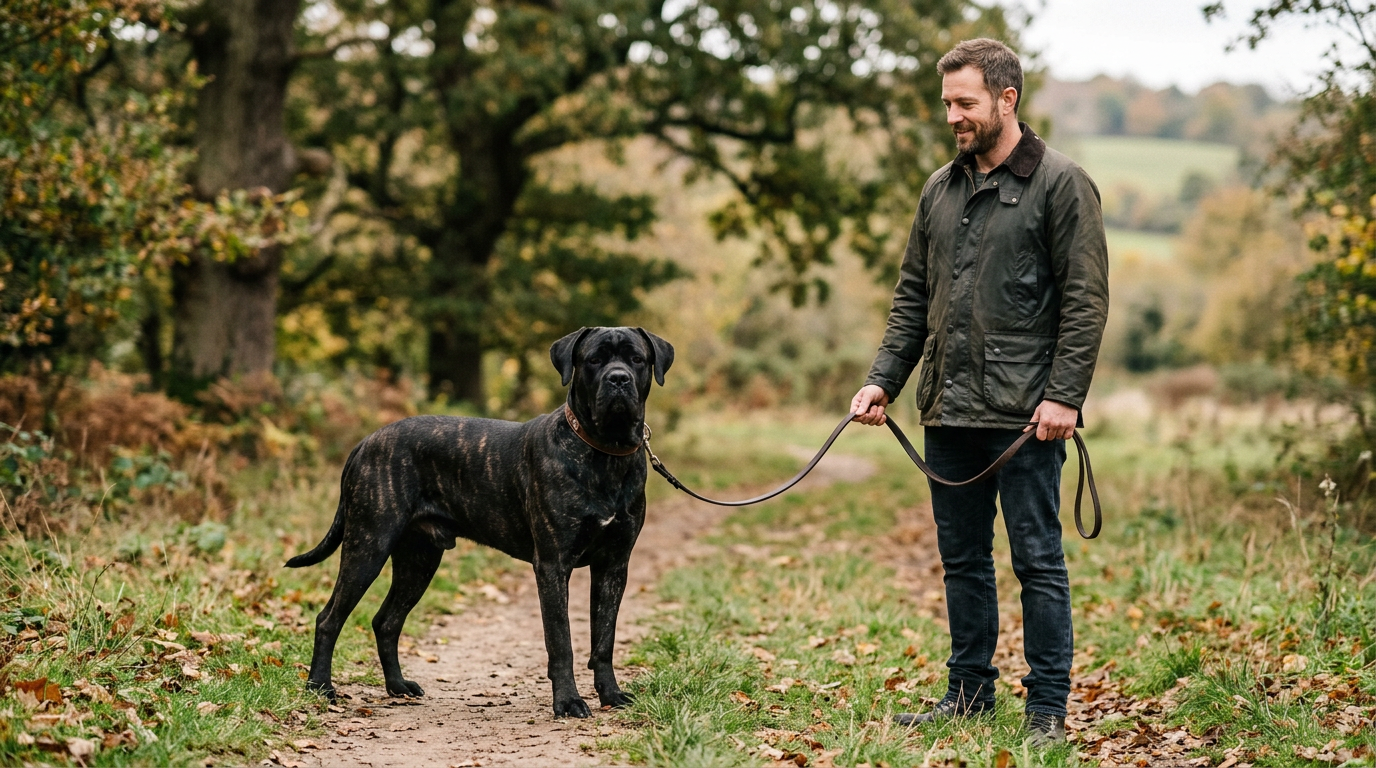
A Cane Corso is a powerful Italian guardian whose calm presence depends on thoughtful breeding, early social learning and skilled everyday handling. This Cane Corso breed guide explains the practical responsibilities: managing a large adolescent, teaching neutral behaviour around strangers, protecting developing joints and planning for substantial food, training and veterinary costs.
Protection is not a party trick. Encouraging suspicion or confrontation can create a dangerous dog and serious liability. A sound companion Corso should learn to look to its owner, disengage from uncertainty and remain safely managed. Choose this breed only if you value stability and control more than an intimidating image.
Cane Corso ratings
These editorial suitability ratings are not scientific measurements or guarantees about an individual. Higher family and trainability scores indicate an easier fit. Higher exercise and grooming scores indicate more owner effort.
| Trait | Rating | Practical meaning |
|---|---|---|
| Family-friendly | 7/10 | Can be deeply devoted, but size, guarding and visitor management demand capable adults. |
| Exercise requirement | 7/10 | Needs daily movement and training without extreme endurance work. |
| Grooming requirement | 4/10 | Short coat is simple, though nails, skin, ears and drool still need care. |
| Trainability | 8/10 | Intelligent and responsive, with little room for inconsistent handling. |
Breed overview
| Breed | Cane Corso Italiano, commonly Cane Corso |
|---|---|
| Origin and purpose | Italian mastiff-type working dog used for guarding and varied farm work |
| Group | Working breed |
| Height reference | Males 25–27.5 inches; females 23.5–26 inches |
| Weight | Proportionate to height; individuals vary substantially |
| Lifespan reference | 9–12 years |
| Coat | Short, stiff coat with a light undercoat that varies seasonally |
| Daily priorities | Training, neutral socialisation, controlled exercise, measured feeding and secure rest |
| Best fit | Experienced owners able to manage strength, guarding and visitors responsibly |
The AKC Cane Corso profile provides the height and lifespan ranges above. The standard uses weight in proportion to height, so chasing a dramatic scale number is inappropriate. A functional dog should be athletic, not deliberately made heavy.
Size and weight
An adult Corso can weigh more than many handlers and produce significant force on a lead. Buy equipment by measured fit and tested strength, not a generic “large dog” label. Harness straps should allow shoulder movement, and the dog must not be able to reverse out.
Teach lead manners while the puppy is small. Physical strength cannot compensate for an adult that has practised lunging for a year. All regular handlers need safe technique and the same rules.
Ask the veterinarian to assess body and muscle condition. The ribs should be assessable beneath a sensible covering, with a shape appropriate to the individual. Excess weight increases load on joints and is not evidence of breed quality.
Lifespan and long-term planning
A 9–12-year planning range includes years of food, insurance or emergency savings, training support, transport and large-dog medication costs. Price veterinary procedures locally; many costs rise with body size.
Plan for reduced mobility before it occurs. Non-slip floors, a low-entry bed and a stable vehicle ramp can help. Teach ramp use and cooperative body handling when the dog is healthy.
Older Corsos still need engagement. Shorter sniff walks, simple searches and calm training can preserve quality of life. New stiffness, night waking, appetite change or reluctance to be touched deserves veterinary assessment.
Temperament and guardian behaviour
A well-suited Corso is often affectionate with family and reserved or observant with strangers. Reserved does not mean fearful, indiscriminately suspicious or uncontrollable. Temperament is shaped by genetics, early experience, health and learning.
Choose for stable recovery. Ask how adult relatives respond after a visitor enters or a sudden noise occurs. A dog that notices and then settles is easier to live with than one remaining intensely aroused.
Socialisation means neutrality
Socialisation does not require every stranger to touch the puppy. Arrange positive exposure at a distance where it can observe, eat and respond. Reward checking in and moving with you. Let the dog opt out of greetings.
Include people with varied appearances, vehicles, veterinary handling, surfaces and calm dogs. Avoid chaotic encounters and uncontrolled dog parks. One frightening or overwhelming experience can be more influential than several easy ones.
Visitors
Use a planned routine. Before opening the door, put the dog behind a secure gate or in a comfortable room. Bring it out on lead only when appropriate, ask visitors to ignore it and reward calm behaviour. Some visitors may never need direct access.
Children’s friends, contractors and medical personnel create unpredictable movement. Management is not a training failure. A guardian breed should not be left to decide who may enter the home.
A practical socialisation plan
A useful Cane Corso breed guide should define socialisation as skill-building, not indiscriminate contact. The puppy should learn that unfamiliar people, animals and places can exist without requiring defence, play or escape. Work below the point where the dog freezes, lunges or cannot eat.
Weeks at home
Let the puppy hear household sounds at low intensity, walk across safe surfaces and see visitors from behind a gate. Reward calm observation. One well-managed visitor is more useful than a crowded gathering where the puppy is passed around.
Practise veterinary-style handling with a chin rest or station: look briefly at an ear, touch a paw and reward. Stop before resistance. Pair the car, clinic entrance and scale with easy visits when possible.
Public exposure
Choose spacious locations with clear exits. Watch people, wheeled objects and calm dogs from a distance. The puppy does not need to greet them. If it stares, stiffens or hides, move farther away and let it recover.
Avoid allowing strangers to lean over, grab the head or deliberately provoke guarding. Advocate for the dog with a simple “no greeting, we’re training”. Safe neutrality protects confidence better than forced friendliness.
Adolescence
Social behaviour can change as guardian instincts mature. Continue controlled exposures instead of assuming puppy friendliness is permanent. Reduce access and consult a professional at the first sign of persistent suspicion, blocking or recovery difficulty.
Hormonal development is not an excuse for threatening behaviour. Medical, environmental and learning factors all matter. Keep a log of triggers and distance so professional advice can be specific.
Exercise requirements
Healthy adult Corsos need purposeful daily exercise but are not endurance sled dogs. Combine controlled walks, sniffing, training and low-impact play. Adjust duration to age, conditioning, weather and health.
Puppies and joint protection
Puppies need self-paced exploration and social learning, not forced running or repeated jumping. Avoid slick floors and endless stair repetitions. Ask the veterinarian about growth, body condition and suitable activity.
Large-breed puppies mature slowly. An adult-sized body may still have developing joints and adolescent judgement. Delay high-impact sport and heavy load-bearing until professional guidance supports it.
Conditioning adults
Build distance gradually and include warm-up and cool-down walking. Vary surfaces sensibly. Weekend exertion does not replace regular conditioning and can increase injury risk.
Watch gait and recovery. Lameness, shortened stride, stiffness, lagging or difficulty rising needs reassessment. Sudden weakness, collapse or severe pain requires prompt care.
Heat and cold
Exercise in cooler hours during heat, carry water and avoid hot pavement. A dark coat, muscular body and strong willingness to follow the owner can mask poor heat decisions. Stop for abnormal panting, weakness or confusion.
The short coat offers limited protection in prolonged cold. Keep outings comfortable, provide a dry resting area and use well-fitted clothing if the individual needs it. Clothing must not rub or restrict movement.
A sustainable weekday routine
Start with a controlled morning walk that allows sniffing and includes several loose-lead or check-in repetitions. Feed after the dog has cooled down, then provide a protected rest period. A short midday toilet break can include calm handling or mat practice.
Use the later main session for a longer walk, scent work, obedience foundations or low-impact play appropriate to age. Finish with a cool-down rather than moving directly from high arousal into visitor activity. The evening should include quiet family time and a final toilet opportunity.
Do not turn every interaction into guarding practice or formal obedience. A Corso needs ordinary opportunities to rest, chew safely and explore. Constant monitoring of the boundary can create a dog that never switches off.
When schedules fail
Arrange a capable backup handler before illness or overtime occurs. A walker must be comfortable with size, equipment and visitor rules. A crowded group-walk service may not be appropriate for every individual.
Indoor scent searches and food puzzles can help during bad weather, but they do not permanently replace movement. Keep floors non-slip and avoid high-impact games in narrow rooms. Resume outdoor activity gradually after a sedentary period.
Grooming
The short coat needs routine brushing to remove loose hair and inspect skin. Shedding may increase seasonally. A rubber curry or short-coat tool should glide without scraping; stop if skin reddens or the dog flinches.
Bathing and skin
Bathe when dirty with a dog-appropriate product, rinse well and dry thoroughly. Check skin folds around the face according to the individual’s anatomy, but do not apply powders or medicated products without veterinary advice.
Persistent odour, itching, bumps, hair loss or recurrent ear problems needs investigation. Grooming can identify a change but cannot determine whether allergy, infection, parasites or another condition caused it.
Nails, paws, ears and teeth
Maintain nails before length alters stance or grip. Train paw handling in short steps and use professional help for overgrown nails. Inspect pads after rough terrain and remove only superficial debris that can be handled safely.
Check ears for pain, redness, discharge or smell without inserting cotton buds. Brush teeth with dog toothpaste as instructed. A large dog with mouth pain may resist examination, making early cooperative care especially useful.
Drool management
Some Corsos drool more than others, especially after drinking, exercise or food. Keep washable cloths near water areas and clean facial skin gently. Sudden excessive drooling can signal mouth pain, nausea, heat illness or another problem and warrants attention.
Feeding
Choose a complete diet appropriate for life stage and expected adult size. Measure the full daily allocation and include rewards, chews and scraps. The WSAVA nutrition resources provide questions for assessing foods and body condition.
Large-breed puppy nutrition
Feed a complete growth food formulated for appropriate large-breed development. Do not add calcium or supplements unless the veterinarian identifies a need. More food and faster growth do not create a better adult.
Track weight, body condition and growth with the veterinary team. Follow an age-appropriate meal schedule. Avoid feeding by an internet adult-weight calculator alone.
Adult portions
Use weight and body condition trends to adjust portions. Set aside part of the meal for training. Store food securely and prevent counter-surfing; a Corso can reach and consume quantities that create an emergency.
GDV awareness
Gastric dilatation-volvulus, or GDV, is a life-threatening condition in which the stomach dilates and twists. Large, deep-chested dogs are at increased risk. Discuss meal patterns, activity around meals and preventive gastropexy with your veterinarian.
Repeated unproductive retching, restlessness, heavy drooling, a swollen abdomen, breathing difficulty, weakness or collapse is an emergency. The Cornell GDV guide stresses immediate medical and surgical intervention. Call ahead and travel promptly.
Common health considerations
This section supports informed questions and does not diagnose an individual. The Cane Corso Association of America’s CHIC list includes hips, elbows, cardiac and patella evaluations plus DNA tests for neuronal ceroid lipofuscinosis and dental-skeletal-retinal anomaly.
Hip and elbow dysplasia
Hip and elbow dysplasia involve abnormal joint development and may lead to pain or arthritis. Ask for identifiable OFA or accepted PennHIP hip results and OFA elbow results for both parents. A normal-looking gait is not formal screening.
In a pet, stiffness, lameness, difficulty rising or reduced activity needs assessment. Management may involve body-weight control, appropriate exercise, rehabilitation, medication or surgery. Never give human pain medicine unless a veterinarian directs it.
Patellar evaluation
Patella screening is part of the listed programme. Ask for registered results and dates. Skipping a hind step, holding a leg up or repeated gait changes warrants veterinary attention rather than manipulation at home.
Cardiac health
A cardiac evaluation should be documented. Ask who performed it and what type it was. A routine puppy check is not necessarily equivalent to the current breeding recommendation.
Collapse, reduced exercise tolerance, unusual breathing or persistent coughing needs veterinary assessment. Severe breathing difficulty or collapse requires emergency help.
Neuronal ceroid lipofuscinosis
NCL is an inherited neurologic condition addressed by a DNA test in the CHIC list. Request results for both parents and ask how the pairing prevents affected puppies. A carrier is not automatically an ill dog; results need correct inheritance-based interpretation.
Dental-skeletal-retinal anomaly
DSRA affects dental, skeletal and retinal development and also has a listed DNA test. The Cane Corso Association of America CHIC page identifies the required screening categories. Ask for the exact DSRA report rather than relying on a claim that a broad panel was clear.
Eyes, skin and eyelids
Some individuals may experience eyelid or eye problems. Squinting, redness, discharge, cloudiness or a painful eye needs prompt care. Do not use leftover eye drops.
Skin and ear disease can also affect comfort. Record location, season and diet changes, then seek diagnosis. Repeated topical treatment without identifying the cause can allow a chronic problem to worsen.
Choosing a responsible breeder
Use the parent club’s current health-testing list as a checklist: hips, elbows, heart, patellas, NCL and DSRA. Verify identifiable records through the OFA database where applicable. Requirements can change, so review the current list when buying.
Ask about longevity, cancer, epilepsy, joint disease, eye issues and temperament in close relatives. A good breeder explains both strengths and uncertainties. No health guarantee substitutes for test results.
Meet adult dogs if possible. Look for stable behaviour, comfortable movement and an ability to recover after visitors or activity. Avoid a seller who celebrates indiscriminate aggression or claims its dogs need no socialisation because they are naturally protective.
Puppies should have age-appropriate exposure, veterinary records, rest and clean space. Read the contract before payment, including return requirements. The breeder should want the dog back rather than allow casual resale.
Training a Cane Corso
Training must begin early and remain reward-based, clear and consistent. A large guardian cannot be safely managed through physical confrontation. Prevent rehearsal, teach useful alternatives and involve a qualified professional before problems escalate.
Foundation skills
Prioritise name response, recall, loose-lead walking, door waits, mat settling, object exchange, muzzle conditioning and cooperative care. Practise in low-distraction places before expecting the cue around visitors.
Reward voluntary calm: choosing the bed, looking away from a stranger or keeping four paws down. These decisions matter more than a long list of performance tricks.
Loose-lead walking
Begin before the puppy is strong. Reward slack, pause when the lead tightens and continue when the dog reconnects. Use equipment for safety, not to create pain. Every regular handler should learn the same method.
Muzzle training
A well-fitted basket muzzle is a useful safety and veterinary-care skill, not a punishment. Teach the dog to place its nose inside voluntarily for food, then build duration and straps gradually. The dog must be able to pant and drink appropriately.
Muzzle training does not make an unsafe situation acceptable. Continue barriers, distance and professional guidance. Never use a tight fabric muzzle for routine exercise.
Resource guarding
Do not repeatedly remove food to prove control. Teach exchange with low-value objects and add good things when approaching. Prevent access to dangerous items through secure storage.
Freezing, hovering, growling or snapping requires distance and qualified help. Punishing warnings may suppress communication without changing the concern. Children must never approach a dog with food or a valued object.
Handling strangers and public spaces
The goal is neutral movement, not compulsory greetings. Create enough distance that the dog can respond, reward check-ins and leave before arousal rises. Do not allow strangers to test whether the dog is friendly.
Follow local leash, housing and breed-specific rules. Insurance and landlord restrictions can change, so verify current terms before obtaining the dog. Responsible management protects the dog as well as the public.
Good with children?
A stable, well-managed Corso can be affectionate with family children, but size and guardian behaviour make supervision non-negotiable. A friendly collision can injure a child. Visitors and children’s friends may be perceived differently from resident family.
Teach children not to hug, climb on, chase or disturb the dog while eating or sleeping. Provide a secure child-free resting area. Adults should control every doorway interaction and separate the dog during running games or parties.
Shared activities can include supervised hand targets or food searches. Adults handle leads, high-value items and conflict. A child should never be asked to demonstrate control over the dog.
Growling, freezing, blocking or persistent monitoring requires immediate management and professional assessment. Sudden irritability also deserves a veterinary check for pain.
Good with cats and other pets?
Compatibility varies with genetics, experience and individual prey drive. A Corso raised calmly with a cat may coexist, while another may chase or control movement. Ask for observed behaviour rather than a breed-level promise.
Begin with separate zones and secure barriers. Reward looking away and give the cat high routes plus access to food, water and litter without passing the dog. Never force face-to-face contact.
Introduce dogs one-to-one in controlled space. Same-sex aggression or intolerance can occur in some individuals, so do not assume puppy sociability predicts adult relationships. Feed separately and provide independent rest.
Small animals require secure physical separation. Size makes even playful contact hazardous. Gates and enclosures must withstand a powerful dog.
Public responsibility and housing
Before acquiring a Corso, verify current local laws, rental terms, body-corporate rules and insurer exclusions. Obtain answers in writing. Rules can apply by breed, size, weight or individual history and may change during the dog’s life.
Keep identification current and use secure equipment in public. Do not allow an uninvited greeting because the other person says they like large dogs. Step aside, create distance and reward the dog for moving with you.
Plan veterinary waiting rooms and narrow entrances. Call ahead if the dog needs space and wait outside when possible. Bring the conditioned muzzle when advised. Clear communication prevents avoidable close encounters.
Responsible ownership also means protecting the dog’s reputation. No intimidation displays at fences, no uncontrolled guarding demonstrations and no off-lead access where the public or animals are at risk.
Apartment suitability
A Cane Corso can be calm indoors, but apartment suitability is limited by size, guarding, lift and corridor encounters, noise and restricted outdoor space. This is not a forgiving setting for weak visitor management.
Plan routes and off-peak times, teach a close pass and use a secure harness. The dog should move behind a barrier before the apartment door opens. Shared lifts require enough space or an alternative plan.
A balcony is not exercise space and must never provide unsupervised containment. Check weight restrictions, rail gaps and climbing risk. Verify lease, insurance and body-corporate rules in writing.
If the dog reacts to corridor sounds, move the bed, add distance and train calm responses. Prolonged barking or guarding at the door affects neighbours and can threaten housing.
Home management for a powerful dog
Use hardware-mounted gates where pressure-mounted models could fail. Check latch height, wall fixings and gaps. A gate is useful only if visitors know not to open it and the dog cannot jump or push it down.
Secure rubbish, medication, tools and food. Put a second barrier between the dog and exterior doors during deliveries. Fencing should be solid, maintained and high enough for the individual, with locked gates where appropriate.
Rest and arousal
Provide a bed away from the front entrance. Reward the dog for choosing it while the home is quiet, then gradually add movement. A guardian constantly stationed at a window rehearses monitoring rather than rest.
After exercise, allow a cool-down and uninterrupted sleep. Overtired adolescents can mouth, jump or patrol more. More stimulation is not always the remedy; a predictable off-duty routine is part of training.
Emergency handling
All adults should know how to attach a lead behind a barrier, use the conditioned muzzle and move the dog into a separate room. Post veterinary and poison contacts where they are accessible. Do not wait for a crisis to find equipment.
If the dog bites or threatens someone, secure it without confrontation, attend to injuries and follow local reporting requirements. Seek veterinary and qualified behaviour assessment. Concealing history increases future risk.
Time alone and travel
Teach short, calm separations before long absences are required. Use a camera. Pacing, drooling, destruction around exits or escape attempts may indicate distress and need professional help.
For travel, use a secured crate or rated restraint suitable for the dog’s size. Confirm that the vehicle, ramp and destination can accommodate it. A sitter must be physically capable and understand door and visitor rules.
Pack measured food, medications, records, spare lead and emergency contacts. Inspect holiday fencing personally. A powerful guardian in an unfamiliar place should not be left to patrol a boundary.
Similar breeds to compare
| Breed | Why compare? | Difference to investigate |
|---|---|---|
| Rottweiler | Powerful working guardian with high training needs. | Compare temperament, health screening and local restrictions. |
| Bullmastiff | Large mastiff-type family guardian. | Often lower exercise, but different drool, heat and health considerations. |
| Boerboel | Very powerful guardian breed. | Often larger and more demanding; assess legal and handling implications. |
| Neapolitan Mastiff | Italian mastiff with guardian ancestry. | More exaggerated skin and body type with different care demands. |
| Boxer | Active, muscular family working dog. | Usually more openly playful, with brachycephalic health considerations. |
Do not compare only appearance. Meet stable adults and ask about strangers, dogs, recovery after excitement and the daily management routine. A mature rescue with assessed temperament may be a better fit than any puppy.
Recommended Cane Corso products
These ratings assess categories for typical usefulness. They are editorial judgements, not laboratory tests or guarantees. No affiliate purchase links are included. Professional fitting matters for equipment used on a powerful dog.
| Product | Best for | Rating | What to check |
|---|---|---|---|
| Complete large-breed food | Measured growth or adult nutrition | 10/10 | Life stage, body condition and veterinary guidance |
| Strong escape-resistant harness | Everyday walks | 9/10 | Shoulder freedom, secure fit and rated hardware |
| Heavy-duty fixed lead | Roads and public control | 10/10 | Reliable clip, comfortable grip and appropriate strength |
| Basket muzzle | Conditioned safety and veterinary care | 9/10 | Pant, drink and treat space with professional fitting |
| Secure mounted gate | Visitors and child separation | 10/10 | Strength, height, latch and wall anchoring |
| Large supportive bed | Joint-friendly rest | 9/10 | Full stretch length, stable base and removable cover |
| Stable vehicle ramp | Reducing repeated jumps | 8/10 | Weight rating, grip, width and secure attachment |
| Large washable food puzzle | Supervised meal enrichment | 7/10 | No swallowable parts and appropriate durability |
| Short-coat grooming mitt | Loose hair and skin checks | 7/10 | Gentle surface and easy cleaning |
Prioritise barriers, walking equipment, identification and a suitable bed. Products do not replace training. Inspect clips, stitching, gates, ramps and puzzles frequently.
Choosing professional support
Look for a reward-based trainer experienced with large guardian breeds and family-home management. Ask what methods, equipment and credentials they use. Avoid anyone promising dominance, instant protection or deliberately provoking the puppy.
A good class has controlled spacing, escape routes and individual adjustment. It should not require every dog to greet. Private sessions may be safer when the dog is already fearful, reactive or difficult to handle.
Keep the veterinarian informed about behaviour changes. Pain, sensory changes and illness can affect tolerance. For serious aggression, ask for referral to an appropriately qualified veterinary behaviour professional rather than relying only on general obedience.
First-month plan
Before arrival, arrange a vet, trainer and emergency clinic; confirm food and health records; secure gates; and prepare a quiet bed. Agree on visitor, door and child rules with every adult.
In week one, prioritise rest, meals, toilet routine and calm exploration. Begin name response, mat work, muzzle introduction and handling. Limit visitors.
During weeks two and three, expand controlled exposure, lead walking and short separations. Use distance, not forced greetings. Monitor gait, appetite and digestion.
By week four, review visitor behaviour, recovery, equipment and workload. Seek qualified help for guarding, fear, dog conflict or lead control before the adolescent becomes stronger.
Questions to answer before choosing a Corso
Can every handler physically and emotionally manage a large guardian without intimidation? Is professional reward-based support available? Can the home separate the dog securely from visitors, children and pets?
Can your housing, insurance and travel plans accommodate the breed for a decade? Is the budget large enough for food, training and weight-based veterinary care? If any answer depends on hoping the dog will be unusually easy, choose a more forgiving match.
Adopting an adult Cane Corso
Request specific observations about strangers, dogs, children, handling, food and time alone. Learn whether the dog was assessed in a foster home or kennel. Obtain medical, legal and bite-history information directly.
Use an experienced rescue and arrange controlled introductions. Keep barriers and leads in place after adoption; a quiet first week does not establish long-term temperament.
Senior care
Large dogs can lose mobility quickly when pain, muscle loss or slippery flooring combine. Add non-slip runners, keep nails maintained and provide a supportive low-entry bed. Use a ramp for the vehicle after teaching it on a shallow incline.
Shorten exercise according to comfort but retain sniffing and simple training. Watch for slower rising, altered stride, reluctance at stairs and new irritability. A guardian may conceal discomfort until it affects behaviour.
Review diet, medication and body condition with the veterinarian. Weight loss is not automatically desirable if it includes muscle. Groom in shorter sessions and inspect pressure points, nails and skin.
Conclusion: is a Cane Corso right for you?
This Cane Corso breed guide describes a capable guardian whose best qualities depend on sound selection and responsible management. The right owner teaches neutrality, controls access, protects developing joints and acts early when behaviour changes.
Verify health screening, prepare professional support and build calm skills before the dog is powerful. In the right hands, a stable Cane Corso can be a devoted, athletic family companion without being asked to prove itself through aggression.
Related breed guides
Compare the Cane Corso with the Rottweiler breed guide and Doberman Pinscher breed guide when considering guardian breeds. Our German Shepherd breed guide offers another working-dog comparison with different ownership demands.
Does this breed fit your life?
Use the dog lifestyle quiz to compare this breed with your home and routine, browse the breed database, or compare breeds side by side before deciding.