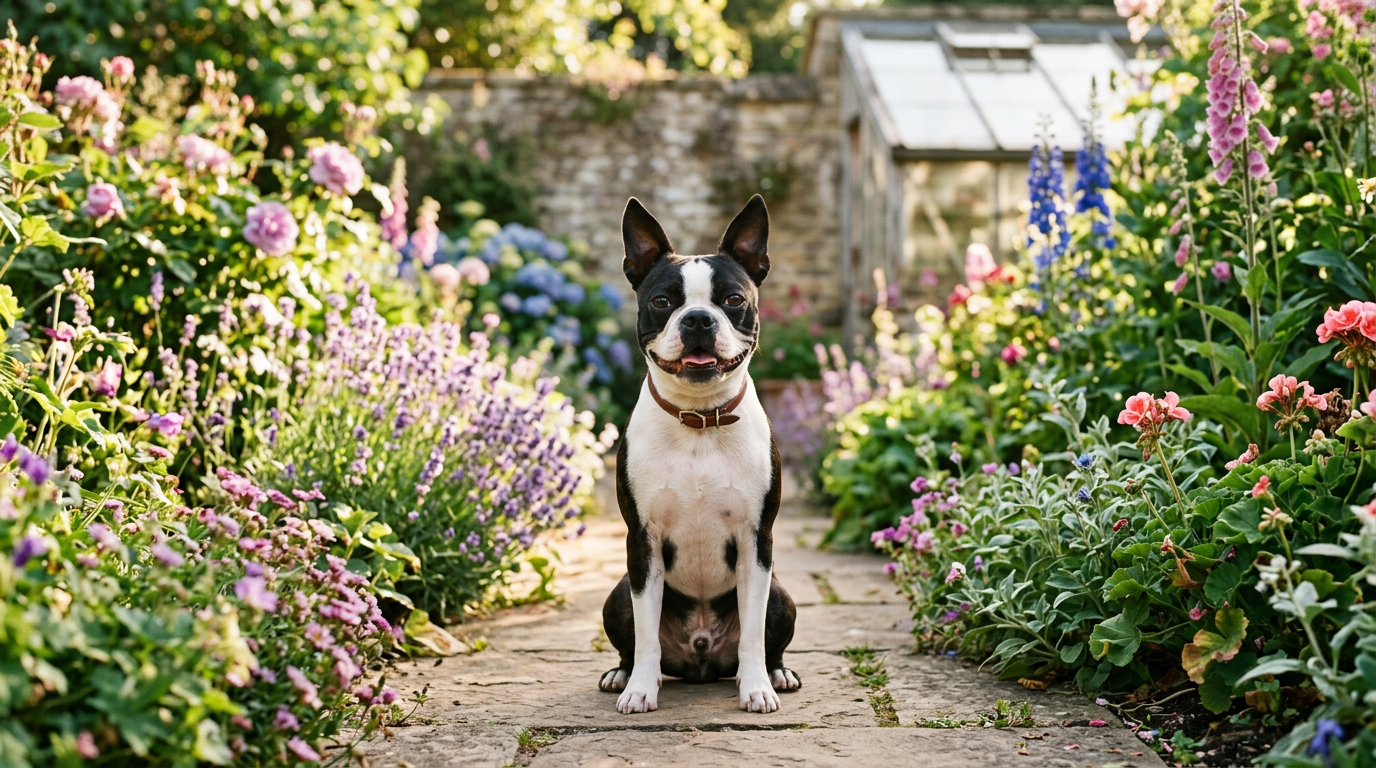
Boston Terrier breed guide searches often begin with the breed’s compact size and friendly expression, but a sensible decision depends on breathing, heat tolerance, eye safety and everyday temperament. Boston Terriers are portable, people-focused companions that often fit urban homes well. They are not maintenance-free, however. Their short muzzle can limit exercise and cooling, their prominent eyes need protection, and poorly chosen dogs may face substantial veterinary costs.
This guide explains what living with a Boston Terrier actually involves. It covers ratings, size, lifespan, temperament, exercise, grooming, feeding, training, children, cats, apartment life, health screening and breed-specific products. It also separates normal dog behaviour from signs that need veterinary assessment. Use breed tendencies as a starting point, then evaluate the individual dog’s airway, movement, confidence and history.
Boston Terrier ratings at a glance
| Category | Rating | Practical meaning |
|---|---|---|
| Family-friendly | 9/10 | Usually social and affectionate, with supervision still essential around young children. |
| Exercise requirement | 6/10 | Needs daily walks and play, but activity must be adjusted for temperature and breathing. |
| Grooming requirement | 3/10 | The short coat is simple; eye, dental, nail, ear and skin care add regular tasks. |
| Trainability | 8/10 | Often responsive and food-motivated, though excitement and sensitivity call for patient training. |
Ratings describe the typical workload, not every dog. A healthy, calm adult may be easier than an adolescent puppy. A Boston Terrier with airway disease, fear or chronic skin trouble may require intensive care. Meet any prospective dog in more than one setting and arrange an independent veterinary examination.
Breed overview
| Breed group | Non-Sporting |
|---|---|
| Height | About 15–17 inches at the shoulder |
| Weight | Usually under 25 pounds; the breed standard uses weight divisions |
| Lifespan | Approximately 11–13 years |
| Coat | Short, smooth and moderately shedding |
| Typical character | Friendly, lively, expressive and strongly people-oriented |
| Best suited to | Owners who want a compact companion and can manage heat, airway and eye risks |
The Boston Terrier developed in the United States and became known for its tidy markings and companionable nature. Modern dogs should be balanced, alert and manageable rather than sharp or chronically anxious. The word “terrier” can mislead prospective owners: many Bostons are less independently driven than traditional working terriers, but they can still chase, play roughly or persist when excited.
Compact does not mean fragile. A sound Boston should move freely, breathe without obvious struggle at rest and remain interested in normal activity. Extreme features are not desirable simply because they look “cute.” Pinched nostrils, constant noisy breathing, exercise intolerance, an inability to sleep comfortably or repeated collapse warrant veterinary assessment.
Size and weight
Most Boston Terriers stand about 15–17 inches and weigh no more than 25 pounds. The breed standard separates dogs into weight divisions rather than giving one ideal number. Body condition matters more than reaching the top of a range. You should be able to feel the ribs with a light covering, see a waist from above and notice an abdominal tuck from the side.
Even a small amount of excess fat can worsen heat and breathing problems. Weigh the dog monthly, use the same scale where possible and ask the veterinarian to record a body-condition score. Reduce calories gradually if the waist disappears; do not crash-diet a growing puppy or make large changes without veterinary guidance.
The Boston’s manageable weight is useful for transport, apartments and older owners, but lifting still needs technique. Support the chest and hindquarters rather than picking the dog up by the front legs. Use a ramp or steps if jumping repeatedly from high furniture aggravates joints, while preventing falls around unguarded stairs.
Lifespan and long-term planning
Boston Terriers commonly live about 11–13 years, with individual variation. Long-term care can include dental treatment, eye emergencies, allergy management, airway assessment or orthopaedic care. Price insurance before a diagnosis creates exclusions, or maintain a dedicated emergency fund that reflects local specialist and after-hours costs.
Record a healthy baseline: resting breathing, tolerance for ordinary walks, appetite, weight, gait and sleep quality. Changes are easier to recognise when the household knows what normal looks like. Snoring may be common in flat-faced dogs, but “common” is not the same as harmless. Increasing noise, interrupted sleep or reduced activity deserves assessment.
Senior care should focus on comfort and function. Add nonslip rugs, maintain muscle through suitable walks, keep nails short and investigate reluctance to jump or use stairs. Schedule veterinary checks at the interval recommended for the dog; older dogs often benefit from more frequent monitoring and screening tests.
Boston Terrier temperament
A typical Boston Terrier is affectionate, curious and eager to join household activity. Many enjoy visitors and form close relationships with several family members. That sociability makes the breed rewarding, but it also means owners should deliberately teach independence. Start with very short calm separations so the dog does not learn that company is available every minute.
Bostons often communicate through movement, facial expression and playful bursts of energy. Some are exuberant greeters. Teach four paws on the floor before jumping becomes a rehearsed habit. Reward a sit or mat settle, and ask visitors to wait until the dog is calm before offering attention.
Sensitivity varies. Harsh corrections can make a worried dog avoid the handler without teaching the desired behaviour. Clear rewards, predictable routines and appropriately easy practice usually work better. If the dog freezes, hides, growls or repeatedly avoids an interaction, create distance and address the reason rather than punishing the warning.
Dog sociability is individual. Some Bostons love compatible playmates; others become selective with maturity. Avoid assuming every compact dog belongs in a crowded dog park. Choose known partners, interrupt escalating play and protect the dog from collisions with much larger dogs.
Exercise requirements
Most healthy adults need daily walking, play and mental work. Two moderate outings often suit better than one long, intense session. Let breathing, temperature, age and recovery determine the plan. A dog should be able to walk comfortably and return to normal breathing promptly after stopping.
Use sniffing and training to add value without excessive exertion. Hide kibble around a room, practise hand targets, teach toy names or scatter food on safe grass. Short scent games can tire the mind while keeping physical effort controlled.
Puppies need free movement and exploration but should not be forced through long runs, repeated high jumps or exhaustive play. Growth plates and coordination are still developing. Allow naps, use nonslip surfaces and end play before the puppy becomes frantic or clumsy.
Boston Terriers are brachycephalic, meaning they have shortened skulls. Some develop brachycephalic obstructive airway syndrome, or BOAS. Cornell lists signs such as noisy or laboured breathing, exercise intolerance, gagging, open-mouth breathing, blue gums and collapse. These are medical issues, not evidence that the dog is lazy.
Heat safety
Flat-faced dogs cannot cool as efficiently through panting when airflow is restricted. Walk early or late in warm weather, stay in shade, carry water and avoid hot vehicles or enclosed sunrooms. Check pavement temperature with your hand, but remember that safe pavement does not mean safe air temperature.
Stop immediately if breathing becomes harsh, the tongue or gums change colour, the dog staggers, vomits, appears confused or cannot recover. Move to a cool place, begin gentle cooling with cool—not ice-cold—water and contact emergency veterinary care. Do not force water into an impaired dog’s mouth.
Humidity, body weight, excitement and individual airway anatomy can make a moderate day dangerous. Use the specific dog’s tolerance rather than a generic temperature cutoff. Air conditioning may be a health requirement in hot climates, not a luxury.
Cold and wet weather
The short coat provides limited insulation. A fitted coat can help in cold rain or winter conditions, especially for seniors and lean dogs. Avoid clothing that compresses the neck or restricts shoulder movement. Dry the skin and paws after wet walks and check for de-icing chemicals or grit.
Grooming
Brush the short coat once or twice weekly with a rubber mitt or soft brush. This removes loose hair and makes it easier to spot lumps, parasites, redness or thinning coat. Bathe when dirty with a mild dog shampoo, rinse thoroughly and dry around the face, neck and tail area.
Facial folds vary. If the dog has folds, inspect them daily and clean only as recommended by the veterinarian. Persistent moisture, odour, redness or discharge can indicate infection. Aggressive wiping can create irritation, so use gentle handling and dry the area completely.
Eye care
Prominent eyes are vulnerable to scratches, ulcers and trauma. Avoid letting the dog push through thorny plants or hang its head from a moving car window. Use a harness rather than applying pressure to the neck, and keep nails short so pawing causes less damage.
Squinting, holding an eye closed, sudden redness, cloudiness, discharge, rubbing or an apparent change in vision requires prompt veterinary care. Eye injuries can worsen quickly. Do not use leftover drops because some medications can be harmful when an ulcer is present.
Nails, ears and teeth
Trim or grind nails frequently enough that they do not alter foot placement. Build cooperation in small steps: touch a paw, reward; hold a toe, reward; introduce the tool at a distance, reward. A groomer or reward-based trainer can help if fear is established.
Check ears weekly for odour, redness, debris or pain. Clean only with a veterinary-approved product and keep cotton buds out of the canal. Repeated infections need diagnosis rather than endless cleaning.
Small mouths can develop crowded teeth and periodontal disease. Brush daily with dog toothpaste when possible. Begin with lip handling and a taste of toothpaste, then gradually add a soft brush. Include dental chews in the calorie total and choose products suited to the dog’s chewing behaviour.
Feeding a Boston Terrier
Choose a complete and balanced food appropriate for puppy growth, adult maintenance or the dog’s medical needs. Measure meals with a gram scale or consistent cup. Feeding guides are starting points; adjust for body condition, activity, treats and veterinary advice.
Keep the dog lean because excess fat can worsen breathing, heat tolerance and joint stress. Treats should generally form a small part of daily calories. Break rewards into tiny pieces; the dog values frequency more than size during training.
Divide food into two or more meals if that suits digestion and routine. Dogs that gulp may benefit from a simple slow feeder, scatter feeding or a food toy, provided breathing remains comfortable and frustration does not increase. Supervise new enrichment items.
Flat-faced dogs sometimes swallow air, regurgitate or struggle with certain bowl shapes. Repeated gagging, coughing with meals, vomiting, poor weight gain or difficulty swallowing needs veterinary assessment. Do not assume all noisy eating is normal for the breed.
Change diets gradually over several days unless the veterinarian instructs otherwise. Persistent diarrhoea, blood in stool, repeated vomiting or refusal to eat should not be managed by rotating foods indefinitely. Seek diagnosis. For home-prepared diets, consult a board-certified veterinary nutritionist so the recipe is complete.
Common health considerations
Brachycephalic obstructive airway syndrome
BOAS can involve narrow nostrils, an elongated soft palate, airway tissue that obstructs the larynx and a narrow windpipe. Severity varies. Noisy breathing, sleep disturbance, exercise intolerance, gagging, blue gums or collapse warrants veterinary evaluation. Weight management and heat control help, but anatomical obstruction may require surgery.
When choosing a puppy, observe both parents awake and after gentle activity. They should move without panic or prolonged respiratory struggle. “All Bostons snore” is not a substitute for assessing airway function. Ask whether either parent has had airway surgery and how relatives cope with normal exercise.
Eye disease and injury
The Boston Terrier Club of America includes a current Companion Animal Eye Registry examination in its health certification. Screening helps identify inherited concerns, but owners must still protect the eyes from injury. Painful eye signs are urgent because corneal damage can progress quickly.
Patellar luxation
A kneecap that slips from its normal groove may cause skipping, intermittent lameness or persistent discomfort. The parent club includes OFA patella evaluation in its program, with formal certification after one year of age. A normal result reduces uncertainty but cannot guarantee every offspring will be unaffected.
Hearing
Congenital deafness can occur. The club’s gold certification includes BAER testing, an objective hearing test performed after 35 days of age. Clapping behind a puppy is not an adequate substitute because vibration or vision can create a response. Deaf dogs can live well with thoughtful visual cues and safety management, but buyers deserve accurate information.
Spinal and neurological concerns
Boston Terriers can be affected by vertebral abnormalities and other spinal problems. Pain, weakness, an unsteady gait, dragging toes or sudden loss of bladder control requires prompt assessment. Discourage dangerous leaps from furniture, maintain healthy weight and use nonslip flooring, but do not restrict normal movement without veterinary advice.
Skin and allergies
Persistent itching, paw licking, recurrent ear trouble or skin infections can indicate allergy or another dermatological problem. Fleas, mites and infection must also be considered. Diagnosis may take time; repeated shampoos or diet changes without a plan often delay effective treatment.
Dental disease
Crowding and short jaw shape can make plaque control difficult. Bad breath, bleeding gums, dropping food or facial swelling needs veterinary attention. Professional dental treatment under anaesthesia allows proper examination and cleaning below the gumline; cosmetic scraping of awake teeth does not treat hidden disease.
Health testing and finding a responsible breeder
The Boston Terrier Club of America’s 2026 health certification identifies CAER eye and OFA patella results for silver certification, with BAER hearing certification added for gold. Ask for registered names and verify results in the OFA database. A generic DNA panel does not replace physical examinations of eyes, knees and hearing.
Ask about airway function, heat tolerance, allergies, eye injuries, spinal disease, seizures, longevity and temperament among close relatives. A responsible breeder discusses problems honestly, raises puppies in a clean and enriched environment, matches temperaments to homes, supplies records and accepts lifelong responsibility for dogs produced.
Be cautious if the seller promotes rare colour above health, cannot produce verifiable results, always has puppies available or claims snoring and exercise intolerance are harmless breed traits. Registration proves ancestry, not health. A veterinary check at vaccination time is not equivalent to breed-specific screening.
For rescue dogs, request medical records, behaviour observations, history with children and pets, response to being alone, toilet habits and known triggers. Foster-home information is valuable. Arrange an independent veterinary examination and plan a quiet decompression period rather than scheduling immediate social events.
Training a Boston Terrier
This Boston Terrier breed guide emphasises training that protects both confidence and breathing: short sessions, comfortable equipment and clear reinforcement.
Boston Terriers often learn quickly when rewards are clear. Start with name response, recall, hand target, loose-lead walking, wait, leave, drop and a settle on a mat. Train for one to three minutes at a time, several times daily, and stop after a useful success.
Use a well-fitted harness that does not press on the throat or restrict the shoulders. Equipment is management, not a cure for pulling. Reward slack lead frequently, change direction before tension builds and choose quiet practice routes. Avoid choke chains and corrections that add pressure to a compromised airway.
To teach calm greetings, prevent jumping with a gate or lead. Reward four paws on the floor, then allow attention. If excitement rises, pause rather than pushing the dog away. Consistent household responses matter more than long formal sessions.
House training requires timing. Take puppies out after waking, eating, drinking, play and active training. Reward immediately after elimination outdoors. Supervise or use a safe pen between trips. Punishing accidents teaches hiding, not bladder control.
Practise cooperative care before it is needed. Reward chin rests, eye checks, paw handling, tooth brushing and standing on a mat. Teach a basket muzzle positively for emergencies; it must allow panting, drinking and treats. Because Boston Terriers rely on panting, fit is especially important and muzzles that hold the mouth closed are inappropriate for routine use.
Recall should be rewarding and protected from failure. Begin indoors, move to a long line in secure spaces and pay generously. Never test recall beside traffic or use it only to end enjoyable activity. A long line must attach to a harness, not the neck.
For fear, aggression, resource guarding or separation distress, seek a credentialed reward-based professional. Growling is useful warning information. Punishing it can remove the warning while leaving the underlying discomfort unchanged.
Are Boston Terriers good with children?
Many are playful and affectionate family dogs, which supports a 9/10 family rating. Their compact size is easier around children than a giant breed, but it does not remove risk. Adults must supervise every interaction and protect the dog from rough handling.
Teach children not to hug tightly, climb on the dog, disturb sleep or take food and toys. Provide a bed or gated area that children never enter. Separate the dog during parties or energetic games if excitement becomes difficult to manage.
Watch for lip licking, head turning, yawning, freezing, hiding or moving away. End contact at the first signs of stress. Never require a dog to tolerate unwanted handling to prove it is “good with kids.”
Are Boston Terriers good with cats?
Many live peacefully with cats, especially when introduced carefully, but chase drive varies. Begin behind gates, keep the dog on lead and reward calm observation and disengagement. Give the cat elevated routes, dog-free rooms and separate feeding and litter areas.
Do not allow repeated chasing, even if it appears playful. The behaviour becomes stronger with practice and can frighten or injure a cat. Progress only when both animals can eat, move and rest normally. Some pairings require permanent management.
Apartment suitability
Boston Terriers are often strong apartment candidates because of their size, moderate exercise needs and social nature. They still need outdoor toilet access, daily walks, training and enrichment. A small home is workable; an unstimulating life is not.
Teach quiet settling and manage hallway triggers. Frosted window film, white noise or distance from the front door may reduce alert barking. Practise short absences to prevent constant companionship from becoming dependence.
Building temperature is critical. A hot top-floor unit or unreliable air conditioning can be unsafe for a flat-faced dog. Check pet rules, nearby shaded walking routes, lift access and the location of emergency veterinary care before choosing the breed.
Similar breeds
| Breed | Why compare | Main difference |
|---|---|---|
| French Bulldog | Compact, social and apartment-friendly | Often heavier-bodied with substantial brachycephalic and spinal concerns |
| Pug | Affectionate, comic and people-focused | Heavier shedding and different eye, skin and airway considerations |
| Miniature Schnauzer | Compact, bright companion | Longer muzzle, higher grooming demand and more alert barking |
| Cavalier King Charles Spaniel | Gentle, portable family companion | Longer coat and different major cardiac risks |
| Rat Terrier | Small, trainable and lively | Longer muzzle, stronger working-terrier drive and more athletic exercise needs |
Compare health burden as carefully as personality. If you want a dog for long runs, hot-climate hiking or strenuous sport, a sound longer-muzzled breed is usually a safer fit. Meet mature dogs and ask owners about ordinary walking, sleep, insurance and veterinary costs.
Recommended Boston Terrier products
| Product | Best for | Rating | Buying guidance |
|---|---|---|---|
| Y-front harness | Everyday walks | 10/10 | Choose adjustable straps, shoulder freedom and no throat pressure. |
| Cooling mat | Warm indoor conditions | 9/10 | Use under supervision; it supplements, not replaces, a cool environment. |
| Portable water bottle | Walks and travel | 9/10 | Select an easy-clean design and offer water during warm outings. |
| Supportive washable bed | Rest and joints | 9/10 | Look for a removable cover and enough room to stretch fully. |
| Soft grooming mitt | Short-coat shedding | 8/10 | Use light pressure and inspect skin during grooming. |
| Dog toothbrush kit | Daily dental care | 9/10 | Use dog toothpaste; introduce handling gradually. |
| Simple food puzzle | Mental enrichment | 8/10 | Avoid deep designs that obstruct comfortable breathing. |
| Nonslip runners | Traction | 8/10 | Place on turning points, beside furniture and along main routes. |
| Crash-tested restraint | Vehicle travel | 9/10 | Confirm size, fit and independent test information. |
| Pet camera | Monitoring absences | 7/10 | Use to observe behaviour, not to replace separation training. |
Affiliate links should be disclosed clearly when added. Ratings reflect breed usefulness, not a guarantee of a specific brand. Check dimensions and return policies, supervise new items and replace damaged equipment.
Travel, boarding and veterinary handling
Travel planning starts with temperature control. Never leave a Boston Terrier in a parked vehicle, even for a brief errand. Pre-cool the car, secure the dog in the cabin rather than an unventilated cargo space and carry water. Schedule breaks in shaded locations and watch breathing after every stop.
Air travel can be especially difficult for brachycephalic dogs, and airline rules change. Some carriers restrict flat-faced breeds because of respiratory risk. Obtain veterinary advice, check the current carrier policy directly and avoid assuming that sedation will make travel safer; sedatives can affect breathing and must never be given without explicit veterinary direction.
For boarding, choose a facility with reliable climate control, overnight supervision and staff who recognise respiratory distress. Provide written instructions describing the dog’s normal breathing, meal routine, exercise limits, veterinarian and emergency hospital. A trial day or short overnight stay can identify stress before a longer trip.
Teach calm veterinary handling while the dog is healthy. Practise standing on a scale, chin resting in a hand and accepting brief eye, ear and mouth checks. Bring high-value treats and tell staff about breathing, fear or previous reactions. Clinics may adjust waiting arrangements to reduce excitement and heat.
Ownership costs and practical budgeting
The Boston’s small appetite can make routine feeding cheaper than for a large dog, but veterinary risk can outweigh that saving. Budget for preventive visits, parasite control, vaccines, dental cleaning, eye emergencies, allergy treatment and possible airway assessment. Surgery or specialist imaging can exceed many years of food costs.
Compare insurance policies using the actual wording. Check hereditary and congenital-condition coverage, waiting periods, annual limits, reimbursement method and exclusions for prior respiratory or eye signs. A low monthly premium is not valuable if common breed risks are excluded. Save policy documents and request pre-authorisation when available.
Routine equipment costs include several harness sizes during puppy growth, secure travel restraint, cooling support, dental supplies and washable bedding. Replace harnesses when straps stretch or stitching frays. Avoid spending heavily on decorative clothing before the dog’s adult measurements are known.
Set aside a separate emergency reserve even with insurance because clinics may require payment before reimbursement. Include the cost of transport to a specialist and time away from work. Financial preparation helps owners act quickly when an eye injury or breathing crisis develops.
Common Boston Terrier ownership mistakes
- Calling breathing noise normal: frequent snorting, sleep disruption and poor exercise recovery need assessment.
- Exercising by the clock: temperature, humidity and the individual airway matter more than a fixed duration.
- Allowing weight creep: small calorie excesses can produce meaningful fat gain.
- Using neck pressure: choose a fitted harness and teach lead skills without airway compression.
- Delaying eye care: squinting and sudden redness are time-sensitive.
- Skipping dental work: bad breath is not an inevitable breed trait.
- Choosing colour over function: health testing, breathing, movement and temperament matter more.
- Assuming small dogs need no training: recall, handling and calm greetings improve safety and quality of life.
Most of these mistakes are preventable through observation and early action. A Boston Terrier should be able to participate in ordinary life without constantly fighting for air. Owners who learn the dog’s baseline and respond to change are better positioned to protect long-term comfort.
First-month care plan
Before arrival, choose a veterinarian familiar with brachycephalic dogs and locate an emergency hospital. Prepare a cool sleeping area, harness, fixed lead, gates, measured food and safe enrichment. Remove access to thorny plants and unsecured balconies.
Keep the first week predictable. Continue the previous food initially, allow generous sleep and introduce people gradually. Begin rewarding the name, following, toilet trips, paw handling and settling. Avoid exhausting “socialisation tours,” particularly in warm weather.
At the first veterinary visit, discuss airway function, nostrils, eyes, knees, hearing, weight, teeth, parasite control, vaccination and insurance. Bring breeder or rescue records. Ask which breathing signs need immediate care and whether further airway assessment is appropriate.
Daily and weekly checklist
- Check breathing at rest and after ordinary activity.
- Provide measured meals and fresh water.
- Plan exercise around temperature and humidity.
- Inspect eyes for pain, redness, cloudiness or discharge.
- Give short training and scent-based enrichment.
- Brush the coat and inspect skin weekly.
- Check ears, teeth, paws and nails weekly.
- Wash bedding, bowls and food toys regularly.
- Record weight and body condition monthly.
- Review harness fit and replace worn equipment.
A checklist cannot rule out illness. Laboured breathing, blue gums, collapse, serious eye pain, repeated vomiting or sudden neurological weakness needs urgent veterinary care.
Is a Boston Terrier right for you?
The breed may suit you if you want a portable, affectionate companion, enjoy short training sessions and can provide a cool environment. You should be comfortable monitoring breathing and eyes, maintaining dental care and paying for breed-related veterinary needs.
Choose another breed if you need a distance-running partner, cannot control indoor temperature or dismiss noisy breathing as normal. The same applies if you want a dog that can routinely spend long days alone. Bostons usually thrive on companionship and structured interaction.
Spend time with healthy adults before deciding. Observe breathing during sleep, calm walking and gentle play. Price local insurance, dentistry, emergency eye care and airway assessment. A realistic plan is more useful than choosing solely from appearance.
Conclusion
A thorough Boston Terrier breed guide should make two points clear: these dogs can be delightful companions, and their flat-faced structure deserves serious attention. Choose for functional breathing, sound movement and stable temperament rather than the shortest muzzle or largest eyes.
Keep the dog lean, protect it from heat and eye injury, train with rewards and verify the parent club’s eye, patella and hearing tests. With those safeguards, a healthy Boston Terrier can offer years of lively, affectionate companionship in homes ranging from apartments to family houses.
Related breed guides
For other compact companions, compare our French Bulldog breed guide and Bulldog breed guide, with attention to their different breathing and exercise needs. Review our apartment-friendly dog breed guide for shared-home planning.
Does this breed fit your life?
Use the dog lifestyle quiz to compare this breed with your home and routine, browse the breed database, or compare breeds side by side before deciding.