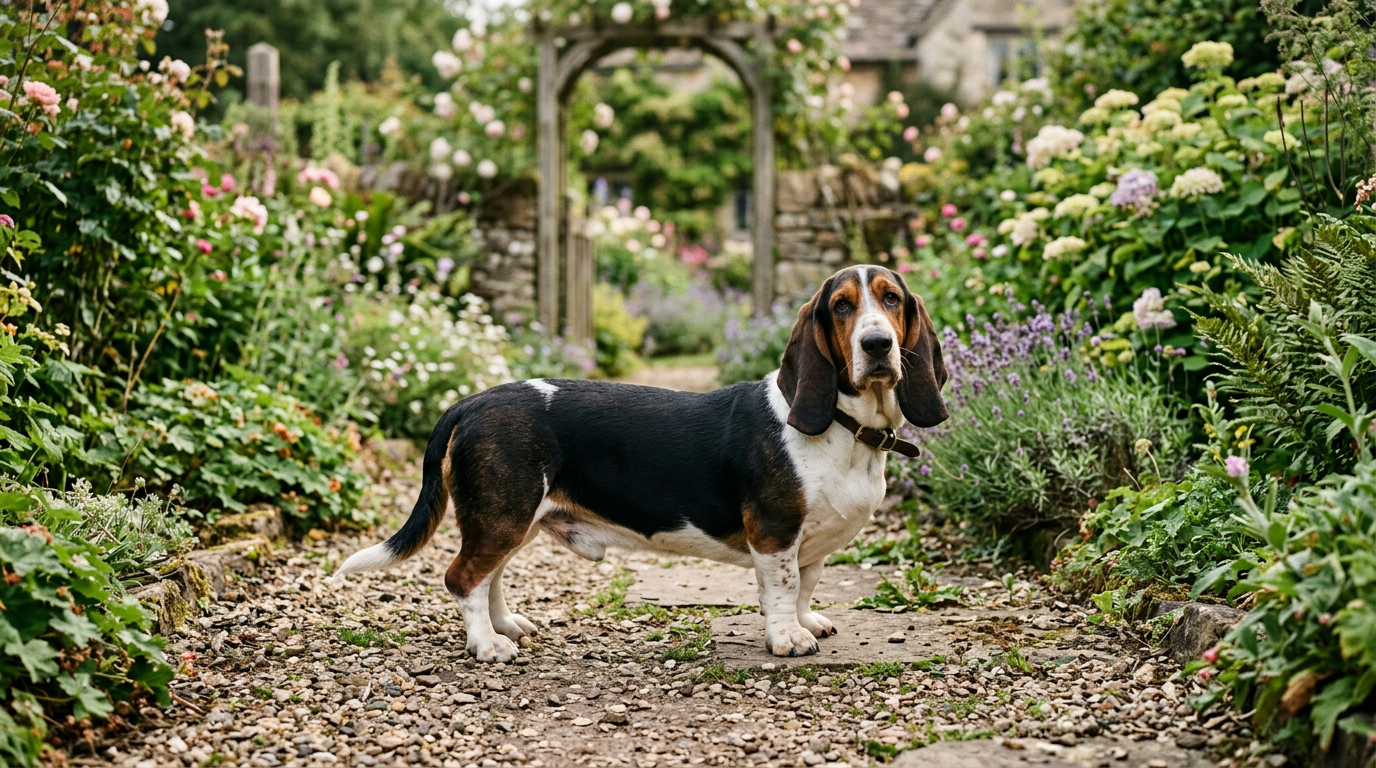
Basset Hound breed guide searches often focus on the long ears and mournful expression, but daily ownership is shaped by scent drive, weight control and a surprisingly heavy body. Basset Hounds are usually sociable, patient companions. They are also independent trackers that may ignore recall when a scent becomes interesting. Their ears, skin, eyes, joints and deep chest require practical preventive care.
This guide covers ratings, size, lifespan, temperament, exercise, grooming, feeding, health testing, training, children, cats, apartment life, similar breeds and useful products. Individual dogs vary. Assess the dog’s movement, breathing, confidence and history rather than relying on appearance alone.
Basset Hound ratings
| Category | Rating | What it means |
|---|---|---|
| Family-friendly | 9/10 | Usually patient and sociable, though interactions still require supervision. |
| Exercise requirement | 5/10 | Needs daily walking and sniffing, with care around joints, heat and body condition. |
| Grooming requirement | 7/10 | Short coat is simple, but ears, folds, eyes, nails and shedding add frequent care. |
| Trainability | 6/10 | Capable learner whose scent-driven independence requires strong rewards and management. |
Breed overview
| Breed group | Hound |
|---|---|
| Height | Up to 15 inches |
| Weight | About 40–65 pounds |
| Lifespan | Approximately 12–13 years |
| Coat | Short, dense and regularly shedding |
| Typical character | Sociable, steady, scent-focused and persistent |
Bassets were developed to follow scent at a pace hunters could track on foot. Their low body and powerful nose remain central to modern behaviour. A secure lead and fence are more reliable than verbal control when a trail captures attention.
Size and weight
Although short, a Basset is not a small dog. Adults commonly weigh 40–65 pounds and carry substantial bone and muscle. Owners may struggle to lift one safely, especially after injury. Plan ramps, low steps and emergency transport before they are needed.
Body condition matters enormously. Ribs should be easy to feel beneath a light covering, and a waist should be detectable from above. Excess fat adds load to the spine, elbows, hips and knees and makes cooling harder. Weigh monthly rather than judging through loose skin.
Use nonslip runners on smooth floors and block repeated leaps from furniture. A stable vehicle ramp can reduce impact. Teach ramp use with low-angle practice and rewards while the dog is healthy.
Lifespan
Basset Hounds commonly live 12–13 years. Long-term planning should include dentistry, ear treatment, mobility care, eye emergencies and possible abdominal surgery. Arrange insurance before symptoms create exclusions or maintain an emergency fund.
Track appetite, weight, gait, resting breathing and willingness to rise. Video normal movement occasionally. Gradual changes are easier to notice when a baseline exists, and early assessment often preserves function.
Basset Hound temperament
Most Bassets are friendly with people and enjoy canine company. They can be comic, affectionate and relaxed indoors. Independence is not lack of intelligence; following scent historically required persistence without constant direction.
Harsh corrections often produce avoidance rather than cooperation. Use food, scent access and predictable routines as rewards. Ask for a simple behaviour before releasing the dog to sniff. This makes the environment part of training.
Some Bassets bay deeply when excited, lonely or alerted. That voice can carry through apartment walls. Teach a mat settle, manage window views and address separation distress rather than treating all vocalisation as disobedience.
Exercise requirements
Healthy adults need daily walking and sniffing. Several moderate outings usually suit better than occasional strenuous exercise. Let the dog investigate safe smells while maintaining a purposeful pace for part of the walk.
Do not mistake a calm indoor style for no exercise requirement. Inactivity promotes weight gain and weakens supporting muscle. Build duration gradually, particularly in a newly adopted or overweight dog.
Puppies need free movement without long forced roadwork, repeated stairs or high jumping. Avoid letting a heavy front end launch from beds or vehicles. Seek veterinary assessment for persistent lameness, reluctance to move or a suddenly altered gait.
Heat requires caution because the body is low to hot ground and excess weight impairs cooling. Walk early or late, use shade and carry water. Heavy panting that does not settle, weakness, confusion, vomiting or collapse requires urgent cooling and veterinary care.
Secure exercise and scent work
Use fenced areas or a long line attached to a well-fitted harness. Never rely on recall beside traffic or wildlife. Check fences at ground level because Bassets can push beneath gaps while following scent.
Hide treats around a room, lay simple scent trails or scatter part of a meal in grass. Mental scent work provides an appropriate outlet and can be more satisfying than repetitive ball throwing.
Grooming
Brush once or twice weekly with a rubber mitt or soft brush to remove loose hair and inspect skin. Bassets shed more than the coat length suggests. Bathe when dirty, rinse thoroughly and dry folds, armpits and the underside.
Ear care
Long, low-hanging ears reduce airflow and often collect moisture or debris. Check them several times weekly for redness, odour, discharge or pain. Clean only with a veterinary-approved product and never push cotton buds into the canal.
Repeated ear infections need diagnosis. Allergy, yeast, bacteria or a foreign body may contribute. Constant cleaning without treatment can irritate the canal and delay effective care.
Skin and folds
Inspect lip folds, neck, armpits and underside. Persistent moisture, odour, redness or greasy discharge can indicate dermatitis. Clean gently as advised and dry completely. Seek veterinary care for painful or recurrent changes.
Eyes, nails and teeth
Drooping eyelids may expose tissue and collect debris. Squinting, cloudiness, redness, rubbing or sudden discharge needs prompt assessment. Glaucoma can be painful and time-sensitive.
Trim nails frequently because long nails reduce traction and alter posture. Brush teeth daily with dog toothpaste. Bad breath, bleeding gums or difficulty chewing needs dental evaluation.
Feeding a Basset Hound
Feed a complete and balanced diet appropriate for life stage. Measure portions accurately and adjust to body condition, activity, treats and veterinary guidance. Do not free-feed a dog that gains weight easily.
Use part of the meal for training and scent games. Small rewards work as well as large ones. Family members should share a single daily treat allowance to avoid accidental overfeeding.
Divide the daily ration into multiple meals if advised. The Basset’s deep chest means owners should understand gastric dilatation-volvulus, or GDV. No feeding routine removes risk, but calm mealtimes and emergency awareness are sensible.
GDV emergency awareness
GDV occurs when the stomach distends and twists. Warning signs include repeated unproductive retching, drooling, pacing, abdominal enlargement, weakness or collapse. The abdomen may not appear enlarged early.
Leave for an emergency clinic immediately if GDV is suspected. Do not wait for a regular appointment or try home remedies. Discuss individual risk and prophylactic gastropexy with the veterinarian; gastropexy reduces twisting risk but does not prevent every episode of dilation.
Common health considerations
Ear and skin disease
Recurrent infections may reflect anatomy, moisture, allergy or microbes. Treatment should be based on examination and testing. Chronic discomfort can change behaviour and sleep.
Eye disease and glaucoma
Bassets can develop glaucoma and eyelid problems. Eye pain is urgent. Responsible breeding programs may use ophthalmic examinations and gonioscopy according to current parent-club guidance.
Orthopaedic and spinal problems
The long back, heavy body and short legs make weight and traction important. Lameness, weakness, dragging toes, severe pain or loss of bladder control requires assessment. Do not give human painkillers.
Bleeding disorders
Basset Hound thrombopathia affects platelet function and can cause abnormal bleeding. Ask breeders about current DNA or laboratory screening recommendations. Unexpected bruising, prolonged bleeding or pale gums warrants veterinary attention.
Heart disease
Coughing, fainting, reduced stamina or rapid resting breathing needs evaluation. A murmur may require echocardiography to identify cause and severity. Weight control supports cardiovascular function but does not treat structural disease.
Health testing and choosing a breeder
Check the Basset Hound Club of America and OFA for the current screening protocol. Discuss eye examination or gonioscopy, thrombopathia testing and any recommended hip, elbow or cardiac evaluations. Requirements change, so verify current guidance.
Search both parents by registered name in public databases. A generic “health checked” statement or consumer DNA panel is not equivalent to breed-specific screening. Ask about glaucoma, bleeding, GDV, joints, ears, temperament and longevity in relatives.
Responsible breeders raise puppies in a clean, enriched home, introduce handling and household sounds, provide records and take lifelong responsibility for dogs they produce. Avoid sellers who cannot provide results, always have litters or market extreme wrinkles and low stature above function.
For rescues, ask about mobility, ears, skin, house training, time alone, children, cats, food guarding and bite history. Arrange an independent veterinary examination soon after adoption.
Training a Basset Hound
This Basset Hound breed guide recommends using the nose rather than fighting it. Teach name response, hand target, recall, loose-lead walking, wait, leave, drop and mat settle. Keep sessions short and reward generously.
Use a fixed lead and well-fitted harness. Reward slack lead and release the dog to sniff after useful check-ins. Retractable leads create unsafe momentum near roads and make consistent handling difficult.
Build recall indoors, then on a long line attached to the harness. Use high-value food and never punish the dog for eventually returning. Recall should not be tested in unfenced areas where scent can override training.
House training and separation
Take puppies out after waking, eating, drinking and play. Reward immediately after elimination. Supervise or use a safe pen between trips. Punishment teaches hiding rather than bladder control.
Practise brief absences from the start. Bassets often value company and may bay when distressed. Use a camera to confirm whether the dog settles. Persistent panic, destruction or continuous vocalising needs qualified behaviour support.
Cooperative care
Pair ear checks, paw handling, eye examination and tooth brushing with food. Teach a chin rest and comfortable basket muzzle. A trained dog is easier to examine when pain changes behaviour.
Are Basset Hounds good with children?
Many are patient and friendly, supporting a 9/10 family rating. Their heavy body can knock over a toddler, and long ears must never be pulled. Adults should supervise and provide a child-free resting place.
Children should not climb on the dog, disturb sleep or take food and chews. Watch for turning away, freezing, lip licking or growling and end interaction early.
Are Basset Hounds good with cats?
Many coexist well with cats, especially with careful introductions, but scent and chase interest vary. Use gates and a lead, reward calm behaviour and give the cat high escape routes and separate resources. Do not allow repeated chasing.
Apartment suitability
A calm adult can live in an apartment if exercise, toilet access and noise are managed. The breed’s bay is the main neighbour concern. Stairs are another practical problem because carrying a 50-pound dog is difficult.
Ground-floor or lift access is valuable, especially after injury. Check building rules and practise calm absences. A yard does not replace daily walks, and an apartment does not prevent good ownership when routines are strong.
Similar breeds
| Breed | Why compare | Key difference |
|---|---|---|
| Beagle | Friendly scent hound | Lighter, more athletic and often higher-energy |
| Bloodhound | Powerful tracking heritage | Much larger, stronger and more demanding |
| Petit Basset Griffon Vendéen | Low scent hound | Lighter, livelier and rough-coated |
| Dachshund | Low body and independent character | Smaller with different spinal and temperament considerations |
| Clumber Spaniel | Heavy, steady companion | Sporting breed with longer coat and retrieval background |
Recommended Basset Hound products
| Product | Best for | Rating | Buying note |
|---|---|---|---|
| Y-front harness | Secure scent walks | 10/10 | Allow shoulder movement and prevent rubbing behind front legs. |
| Fixed-length lead | Controlled walking | 9/10 | Choose strong stitching and hardware. |
| Long line | Recall practice | 9/10 | Attach to a harness and use away from traffic. |
| Supportive low bed | Joints and rest | 9/10 | Choose a washable cover and low entry. |
| Nonslip runners | Indoor traction | 9/10 | Place along main routes and turning points. |
| Rubber grooming mitt | Shedding | 8/10 | Use gentle pressure while inspecting skin. |
| Veterinary ear cleaner | Routine ear care | 8/10 | Use only under veterinary guidance. |
| Slow feeder | Dogs that gulp food | 8/10 | Choose broad grooves and easy cleaning. |
| Vehicle ramp | Reducing jumping | 9/10 | Check grip, width and rated weight. |
Affiliate links should be disclosed clearly when added. Ratings reflect breed usefulness, not a warranty. Check dimensions, supervise new equipment and replace worn items.
First-month plan and ownership costs
Choose a veterinarian and emergency clinic, install gates and runners, and prepare a harness, fixed lead, bed, ear-care supplies and measured food. Keep the first week predictable and introduce new experiences gradually.
Budget for food, parasite prevention, insurance, ear and skin treatment, dental care, ramps and emergency assessment. Boarding may cost more because of body weight and medication needs. Maintain an emergency reserve even with insurance.
Common ownership mistakes
- Allowing weight gain beneath loose skin.
- Trusting recall around open roads.
- Cleaning painful ears without diagnosis.
- Using stairs and furniture jumps without planning.
- Underestimating baying in shared housing.
- Calling repeated skipping or lameness normal.
- Providing food rewards without adjusting meals.
- Choosing exaggerated appearance over sound movement.
Daily and weekly care schedule
| Frequency | Task | Why it matters |
|---|---|---|
| Daily | Measured meals and fresh water | Supports reliable weight control and appetite monitoring. |
| Daily | Walks, sniffing and short training | Maintains muscle and provides an outlet for scent behaviour. |
| Several times weekly | Ear inspection | Finds moisture, odour, redness or discharge early. |
| Weekly | Brush coat and inspect folds | Removes loose hair and reveals skin changes. |
| Weekly | Check nails, paws and eyes | Protects traction and identifies pain promptly. |
| Daily if possible | Brush teeth | Reduces plaque and supports gum health. |
| Monthly | Record weight and body condition | Prevents slow weight gain from being hidden by loose skin. |
The schedule should be adjusted for medical needs. A dog with active ear disease may require a prescribed treatment plan, while a senior with arthritis may need more frequent mobility review. Routine care is useful because it establishes normal; it does not replace veterinary diagnosis.
Senior Basset Hound care
Ageing Bassets often need changes before they stop enjoying activity. Replace long outings with shorter, more frequent walks and allow extra sniffing time. Controlled movement supports muscle, while weekend overexertion may create several painful recovery days.
Use ramps, block high furniture and place nonslip runners from bed to water and toilet exits. Keep nails short and provide a supportive bed with low sides. Discuss pain management with a veterinarian; human anti-inflammatory drugs can be toxic.
Track resting breathing, appetite, thirst, urination, stool, sleep and willingness to rise. Gradual hearing or vision loss can make a dog startle, so approach predictably and teach children not to wake it by touch.
Weight loss in a senior is not always desirable. Unexplained loss can indicate dental pain, gastrointestinal disease, cancer or another illness. Record changes and arrange assessment rather than simply adding richer food.
Travel and boarding
A Basset’s weight and short legs make vehicle setup important. Use a stable, wide ramp with a grippy surface and secure the dog in the cabin. Condition the ramp at a shallow angle before using it at full vehicle height. Never pull the dog up by a collar.
Pack measured food, medication, ear supplies, a harness, records and familiar bedding. Identify an emergency hospital at the destination. Avoid long walks immediately after arrival; let the dog investigate the new environment on lead and establish toilet areas.
Choose boarding staff comfortable handling heavy, low dogs and managing ears, skin and mobility. Provide written instructions and use a trial day before a longer stay. Verify climate control and whether staff are present overnight.
Frequently asked questions
Are Basset Hounds lazy?
They are often calm indoors, but healthy dogs still need daily activity. Apparent laziness can also reflect obesity, heat, pain or poor conditioning. Build exercise gradually and investigate a sudden decline.
Can Basset Hounds go off lead?
Only in securely fenced spaces. Even a well-trained Basset can follow scent beyond hearing distance. Use a long line on a harness for freedom in open areas.
Why do Basset Hounds smell?
Normal coat oils, drool and long ears contribute to a characteristic odour, but strong or changing smell may indicate ear, skin, dental or anal-gland disease. Bathing more often will not cure infection.
Do Basset Hounds swim?
Their heavy front, short legs and long body can make swimming difficult. Do not assume natural ability. Use a properly fitted canine flotation device around water, supervise closely and provide an easy exit.
How much do they shed?
The short coat sheds regularly. Weekly brushing reduces loose hair but will not eliminate it. During heavier shedding, several brief grooming sessions are preferable to aggressive scraping.
Is a Basset Hound right for you?
The breed may suit you if you want a sociable, steady companion, enjoy relaxed scent walks and can manage ears, weight and secure containment. Owners should be patient enough to train with rewards rather than expecting instant obedience.
Choose another breed if deep vocalisation would cause housing problems, stairs are unavoidable or off-lead reliability is essential. The same applies if routine ear checks, measured feeding and emergency lifting plans feel excessive.
Spend time with healthy adults and observe movement, breathing and recovery after a walk. Price local insurance, dentistry, ear treatment and emergency care. A realistic ordinary-week plan is more useful than choosing from appearance alone.
Preparing for veterinary visits
Teach the dog to step onto a low scale, stand on a nonslip mat and accept brief ear, eye and paw checks. Bring high-value rewards and tell clinic staff about pain or fear before handling begins. A positively trained basket muzzle is sensible emergency preparation; it must allow panting, drinking and treats. Cooperative skills are particularly valuable because lifting or restraining a heavy, uncomfortable Basset can injure both dog and handler.
Ask the clinic whether a ground-level entrance and extra handling assistance are available before an urgent visit becomes necessary.
Conclusion
A practical Basset Hound breed guide centres on weight control, secure scent outlets, ear and skin care, joint protection and patient training. The breed can be a warm, steady family companion when owners respect its nose and physical structure.
Verify current health testing, plan emergency transport and teach cooperative care early. Those preparations turn the Basset’s independence from a daily conflict into a manageable, enjoyable part of ownership.
Related breed guides
For a smaller scent-driven companion, compare the Beagle breed guide and Dachshund breed guide. Before choosing any hound for a flat, review our guide to dog breeds for apartment living.
Does this breed fit your life?
Use the dog lifestyle quiz to compare this breed with your home and routine, browse the breed database, or compare breeds side by side before deciding.